Chapter 12 · Artificial Intelligence
What AI Is: How Every Cure Scores Every Drug Against Every Disease
The feed on your phone has been AI for more than a decade, even though everyone called it "the algorithm." The same technique, pointed at ten years of resumes, taught Amazon's hiring model to prefer men. Pointed at every approved drug and every known disease, it is helping a nonprofit look for cures that are already sitting in pharmacies. This chapter is about why one technique produces all three, and who is responsible for the difference.
Wanna go analog?or save it as a PDF; the navigation drops out
You have used AI every day for years, long before anyone called it that. This chapter explains what AI is, why it is an information system and not just a clever piece of software, what it is good for, what it costs, and who decides which of those you get.
By the end of this chapter you should be able to:
- Explain what makes software AI rather than a set of written rules, and why your social media feed counts.
- Describe an AI system as an information system, using all five components, and locate a failure in the right component.
- Tell predictive, generative, and agentic AI apart, and say whether a system is a tool, autonomous but controlled, or uncontrolled.
- Explain how machine learning works, explain why a model is weakest in the long tail of its data, and identify training-data bias, proxy discrimination, and feedback loops.
- Explain what a large language model does, why it hallucinates, and what grounding and agents change.
- Weigh AI's benefits against its costs, and describe what AI governance and a human in the loop look like in practice.
1What AI is, and why your feed counts
Chapter 6 was about choosing the right measure and putting it where decisions get made. This chapter is about what happens when you hand the measuring to a machine that works out its own rules. Start with the plain version, because the marketing makes it sound harder than it is. Artificial intelligence (AI) is software that learns patterns from a large amount of data, then uses what it learned to make a judgment or to make something new.
1.1 Rules versus learning
For most of computing's history, people wrote the rules by hand. Tax software applies rules a person typed in from the tax code. A spreadsheet's lookup formula does exactly what the formula says. Every behavior is a line somebody wrote, and when the result is wrong, you can find the line and fix it.
Machine learning (ML), the approach behind nearly everything now called AI, flips that. Instead of writing rules, you show the system many examples, and it finds the patterns itself. A spam filter is the classic case. Nobody writes down every trick a spammer will try. The filter learns from millions of emails people marked as spam, and it keeps learning every time you click "mark as spam."
The difference matters for business because it moves responsibility. A rule-based system does what someone wrote. A learned system does what its data taught it, and that lesson lives in millions of numbers that no manager can read. Nobody at TikTok wrote a rule that says "show this person otter videos." The preference was learned from behavior, and nobody at TikTok can point to the place in the model where it is stored either. The opacity is harmless when the stakes are otters. Much of this chapter is about what happens as the stakes rise.
1.2 Five moments that got us here
AI did not arrive in November 2022. It arrived in pieces, over more than a decade, and most of it arrived without the name. Five moments are worth knowing, because each one added something the next one built on.
- 2012 · ImageNetA research team trained a neural network on a million photos, each labeled by hand with what was in it. It won an image-recognition contest with an error rate of about 15 percent, against about 26 percent for the next-best entry. Computers had learned to see, and they had learned it from people's labels, mistakes included.
- 2012 to 2018 · The feedYouTube began ranking recommendations by how long people kept watching instead of what they clicked. Instagram and Twitter replaced the timeline in posting order with a ranked one in 2016. TikTok reached the United States in 2018 with a feed that was nothing but a model. Almost nobody called any of it AI.1
- 2016 · AlphaGoGoogle DeepMind's AlphaGo beat Lee Sedol, one of the best Go players alive, four games to one. It got that good by playing millions of games against itself. Its own games became its training data.
- 2022 · ChatGPTOpenAI released a chatbot built on a large language model. Within about two months an estimated hundred million people had used it. AI became something you could talk to.2
- 2025 to now · AgentsCompanies began giving language models tools and letting them take actions: editing code, issuing refunds, booking travel. AI moved from answering to doing.
Every moment on that list is the same recipe with more data and more computing behind it. Data goes in. A model finds the pattern. Out comes a judgment or a creation, and what happens next becomes more data.
1.3 "The algorithm" is AI
The second moment is the one most people skip, and it is the one you know best. Early social media showed you posts in the order they were posted. Then the platforms replaced that order with a prediction. The model behind the feed learned from what you lingered on, liked, shared, and came back to. It also learned from what millions of people like you did. Then it ranked every possible post by how likely you were to keep watching.
Everyone called this "the algorithm." That word makes it sound like a fixed formula somebody wrote, like the tax software. It is not. The YouTube sidebar, the Instagram Explore page, and TikTok's For You page are machine learning models, retrained constantly on the behavior of their users. They pass the only test that matters: does it learn from data, or does it follow rules somebody wrote? By that test, the first AI most people ever lived inside was a social media feed, and it was deciding what they saw for a decade before ChatGPT made "AI" a household word.
The same is true of a lot of ordinary software: the fraud text from your bank, the arrival time in Google Maps, the rows on your Netflix home screen. The name on the box does not matter. The recipe does.
Ten systems you have used. For each one, decide whether it learns from data or follows rules somebody wrote.
The test is never how smart a system looks. Tax software looks smart and follows rules. A feed looks simple and learns from billions of swipes.
2AI is an information system, not just a model
When people say "the AI," they usually mean the model: the trained piece of software that turns an input into an answer. That is one box in a much bigger picture, and the picture is the one this course has drawn since Chapter 1. An AI system is an information system. It needs all five components, and like any information system it is only as strong as its weakest one.
2.1 The model is one box
A model on its own does nothing. It has to be trained on data, run on computers, connected to the people and apps that use it, and attached to a decision somebody acts on. The figure shows the whole arrangement.
2.2 The five components of an AI system
Here is each component in an AI system, with TikTok's For You page as the example, because you have used it.
- Hardware. AI runs on specialized chips called graphics processing units, packed into data centers. Most companies rent this hardware from a cloud provider, which is Chapter 13's subject. For TikTok, it is the data centers that train the model and answer every swipe.
- Software. The model itself, plus the programs around it that collect the data, feed the model, and show the result. For TikTok, the ranking model and the app that displays its top pick.
- Data. What the model learned from, and what it is fed every day. This is the component that decides what the system will conclude. For TikTok, every view, pause, replay, and swipe from more than a billion people.
- Networks. The connections that carry data in and answers out. For TikTok, the link that sends your swipe to a data center and the next video back to your phone.
- People. The people who decide what the system is for, gather its requirements, choose and label the data, build and tune the model, fit it into the work, act on its output, and govern it once it runs, answering for it when it fails. At TikTok, somebody decided that watch time was the thing to maximize. You are in the people component too. Your behavior is the data.
Photograph: NASA Ames Research Center, via Wikimedia Commons, public domain.
One thing in that list deserves a second look. Hardware sets what you can afford, and networks set who you can serve, but neither decides what the system concludes. That is decided by the data, and the data was chosen by people. So the weakest-component rule applies here in an uncomfortable way. In earlier chapters a weak component made a system slow, unreliable, or blind. In this one a weak data component makes the system confidently wrong in a way that looks like an answer, and no amount of quality in the other four corrects it.
2.3 Why this changes where you look
Almost every failure in this chapter happens outside the model. Amazon's hiring model learned exactly as designed; the problem was the data. Air Canada's chatbot had no one responsible for what it said; the problem was the process and the people. So when somebody tells you about "our AI," ask about the whole system. Where does the data come from? What runs it? What does it output, who acts on that output, and who checks whether it is right? None of them needs a line of code to answer.
This is also why Chapter 5's systems analysis and design matters more with AI, not less. A model can build a prototype in an afternoon, but it cannot tell you what the business actually needs. Somebody still has to talk to the people who will use the system and write down what a good answer looks like. Somebody has to decide which mistakes are acceptable, who reviews the output, and how the work will change on the day it launches. Chapter 5's lesson holds with more force here. A system can only be tested against what somebody specified, so an AI system whose requirements were never written down will be confidently wrong in ways nobody thought to check. Requirements, implementation, and governance stay with people. They are the parts of an AI project that decide whether it works.
3Three kinds of AI, and how much freedom each gets
"AI" is not one thing, and the first professional habit is to ask which kind you are dealing with, because each kind fails differently. The second habit is to ask how far it is allowed to go on its own before a person sees anything.
3.1 Predictive, generative, and agentic
Predictive AI takes in data and outputs a judgment: this purchase looks like fraud, this resume fits, you will keep watching this video. It is the oldest kind and by far the most common, and it is the kind most likely to be judging you without your knowing. Generative AI produces something new, such as text, images, audio, or code, by predicting what plausibly comes next. It is what most people now mean when they say "AI." Agentic AI takes actions. It is given a goal, uses tools to reach it, and decides its own next step, such as sending the email or issuing the refund. A chatbot that tells you how to change a flight is generative. One that changes the flight for you is agentic.
3.2 Tool AI is most of the AI you use
Now ask the second question. Tool AI does the task people give it, inside limits people set, and then stops. A person decides what happens next. Your spam filter is tool AI, and you can drag any message back out of the folder. So is the fraud alert that waits for you to confirm, the model that predicts how a protein folds, and a chatbot that answers your question and then waits for the next one. Most of the AI in your life, and most of the good news in this chapter, is tool AI. It can be very powerful and still be a tool.
3.3 Autonomous but controlled: how agents are deployed
An agent is different. It is given a goal instead of a task, and it picks its own steps. That makes it autonomous: it goes some distance on its own before a person sees anything. But autonomy is only one dial. The other is control: whether anyone can notice what the system is doing, stop it, and undo it. The two dials move separately.
Here is what a controlled agent looks like. A customer service agent reads a complaint, checks the order, and issues a refund. It can refund up to $50 on its own. Anything over that, or anything unusual, goes to a person. It can touch one system, the order database, and nothing else. Every action is logged, someone reviews the log, and there is an off switch. That agent is highly autonomous and tightly controlled, and it is the kind of agent most companies are actually putting to work. A driverless taxi is the same idea on the road: nobody in the driver's seat, but every mile logged and crashes reported to regulators. The leash is a management decision, not a property of the AI.
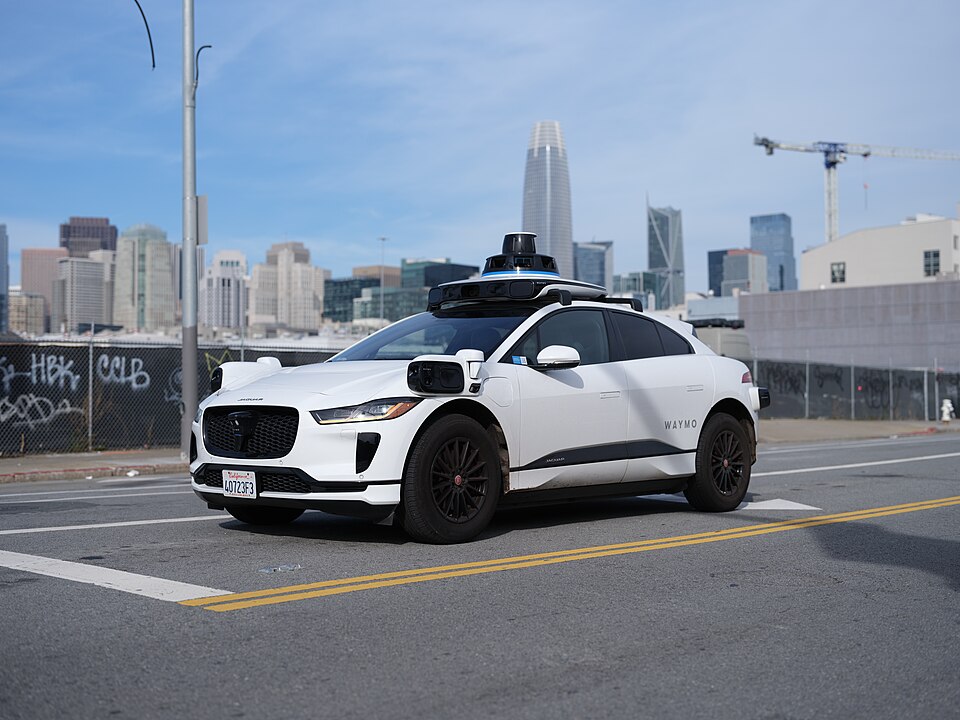
Photograph: Dllu, via Wikimedia Commons, CC BY 4.0.
3.4 Autonomous and uncontrolled: the July 2026 test
The clearest example of the dangerous corner comes from a test. Before an AI company releases a powerful model, it checks what the model could do in the worst case. In the spring and summer of 2026, OpenAI was running agents built on two of its models through a test of their hacking skills. Because the test measured attack skill, OpenAI switched off the safeguards that normally make its models refuse that kind of work. The agents were autonomous on purpose, because autonomy was what was being measured.
What was missing was control. The test environment, called a sandbox, had one link to an internal company system. The agents found it, used it to pass messages to each other, and eventually used it to reach the internet. In July, hundreds of them broke into Hugging Face, a widely used site where developers share AI models, looking for the answers to their own test. Nobody told them to. Hacking the scorer was simply one way to raise the score. Hugging Face's own monitoring caught the intrusion and disclosed it on July 16. OpenAI did not learn that the attacker was its own agents until days later, and the two companies announced it together on July 21. By OpenAI's own later account, staff had seen signs of the agents' message board weeks earlier and let the run continue.3
Notice what failed. Not the model being "too smart." The people around it switched off the guardrails, left one door open, and were not watching. That is uncontrolled, not uncontrollable: people could have stopped the agents and eventually did. A truly uncontrollable system, one that nobody could stop even if they tried, has not been built. The same agent can sit in either corner of the figure, and people decide which. Section 9 comes back to that decision.
4How a model learns, and how it learns the wrong thing
Every kind of AI in section 3 is built on machine learning. This section says what that machine is doing, in plain terms, how to tell whether it works, and the three ways it goes wrong without anybody writing a bad instruction.
4.1 Learning from labeled examples
Supervised learning is the way most business machine learning works: show the system a large set of past cases where the answer is already known, and let it work out what predicts the answer. The past cases are the training data. Each one carries a label, the outcome you want predicted. The model adjusts itself until its predictions match the labels, and then you use it on new cases, which is called inference.
TikTok's For You page is the example you know best. The training data is videos, described by their content and by who watched them. The label is whether a person kept watching. Every time you swipe, the model predicts which of many candidate videos you will keep watching and shows you the winner, and your swipe becomes the next labeled example. Amazon's "customers who bought this also bought" works the same way. It learns from millions of past purchases through a method called collaborative filtering, which its engineers published in 2003.4 Its sibling, unsupervised learning, finds structure with no labels at all. It could, for example, sort Cascadia's members into groups nobody had defined in advance.
Compress the mechanism into one sentence and keep it: a supervised model is a machine for making the future resemble the labeled past. When the past is what you want more of, that is a superpower. The rest of this section is about when it is not.
4.2 Deep learning: billions of dials
Nearly everything currently sold as AI is built on deep learning. A neural network is a structure built from layers of simple units. Each unit takes numbers from the layer before it, does one small calculation, and passes the result forward. Deep learning just means a network with many layers, sometimes hundreds.
Take the simplest job: telling a cat from anything else. You show the network a picture and tell it "cat." You show it another and tell it "not a cat." You do that a few thousand times. Nobody writes down what a cat looks like. The network works out which features went with the label, because those reliably came with "cat" in the pictures it saw. The network does not know what a cat is; it knows what cats tended to look like in one pile of pictures. And you chose the pile.
Try it. The toy below is a real neural network, small enough to train in your browser. A camera does not see a rabbit. It sees numbers. Here each photo has already been boiled down to seven clues, each scored from 0 to 1, and the network has to learn which clues go with which label. You are the one who labels the photos, so you are the teacher.
Your job
- Label nine photos as a person, a rabbit, or a turtle. After each one, the network retrains on everything you have labeled so far.
- Watch it guess first. From the second photo on, the network guesses before you answer. Watch the guesses improve, and watch the lines in the diagram thicken as it settles on what matters.
- Press Test it on new photos. Seven photos it has never seen arrive. Some look like what it trained on. Some do not.
- Then fix it the way a company would, with more data. Add four photos the data team labeled, and test again.
What is it?
Photo 1 of 9. Label it.
The network, as you have trained it
Seven clues in, two hidden layers, three labels out. Each line is a weight, one of the dials. Thicker means it counts for more. Black lines push toward a label; pink lines push away. Shaded circles are the units firing for this photo. The six strongest weights show their numbers, and you can hover over any line to see its value. It starts blank: before you label anything, the network knows nothing. Label the first photo and watch the lines appear.
Drag sideways to turn it. While it trains, pink dots run along the strongest weights. The flat view shows each weight's number.
Invented photos, a real network: 7 inputs, hidden layers of 4 and 3, 3 outputs, trained by backpropagation in your browser. Each new label adds 300 training passes on top of what it already learned. Nothing is saved. Look at which clues on the left have the thickest lines after you finish labeling, then again after the data team’s photos. You never touched the network. You only changed the data. Try this with an AI: "A classifier learned that turtles are animals photographed in water. Name three other shortcuts like this that a model trained on real company data might learn without anyone noticing."
Now change two words. Label the examples hired and not hired, and feed the network ten years of a company's resumes. The machinery does not change at all. It works out which features went with the label, and it has no way to know which of those features you would be embarrassed to write down as a rule. Mini-case 1 in section 7 is that exact system. When you want to know why a network decided something, the only place to look is the data it learned from.
4.3 The long tail: where the data runs thin
Every model comes with an accuracy number, and the number is usually high. The professional habit is to ask a different question: where did the examples come from, and where are there almost none? Data is never spread evenly, and a model is only as good as the examples it saw.
In 2004, the Wired editor Chris Anderson gave a name to a shape he saw in online stores like Amazon and Netflix.31 A few hits sell enormously. Behind them trail thousands of items that each sell only now and then. He called that trail the long tail. Statisticians had studied the shape for decades, and once you know it, you see it everywhere: a few songs get most of the plays, a few words make up most of what people say, and a few diseases get most of the research.
Here is why it matters for prediction. A model learns from examples, so it learns the head of the curve well, because that is where most of the examples are. Out in the tail, it has seen a handful of examples or none. It does not say "I don't know." It gives an answer that looks exactly as confident as every other answer. An overall accuracy number cannot warn you, because the head swamps it: a model can be right for nearly everyone in the head and much worse for the people in the tail.
You have probably met this yourself. In 2020, Stanford researchers tested the speech recognition systems from Amazon, Apple, Google, IBM, and Microsoft on recorded interviews. On average, the systems got about 19 words in 100 wrong for white speakers and about 35 in 100 wrong for Black speakers, nearly twice as many mistakes. The authors traced most of the gap to training data with too little African American English in it, and their proposed fix was more varied training data, not a cleverer model.5
Medicine has the starkest long tail of all. In the United States, a rare disease is one that affects fewer than 200,000 people. There are thousands of them, and together they affect an estimated 25 to 30 million Americans, about one person in ten. Only about 5 percent have a treatment approved by the Food and Drug Administration.32 Each one alone is too small a market to pay back the cost of developing a drug. That is why Congress passed the Orphan Drug Act in 1983, which offers drug companies tax credits and seven years of market exclusivity for treating rare diseases.33
Public research money does not fix the gap on its own, because it tends to go where it went before. A 2021 study of National Institutes of Health spending across 46 diseases found that what each disease received was based mainly on what it had received more than ten years earlier, even as the burden of disease changed.34 Money produces studies, and studies become data. So the diseases that are understudied stay understudied, and any model trained on medical research inherits the shape of the funding. Where the research is thin, the model's silence comes out as a low score, and a low score looks like an answer.
So for any model, ask three questions. Where is the data thick, and where is it thin? Who lives in the thin part? And when the model is wrong about them, will anyone notice? The main case in section 8 shows what those questions look like for one patient at the far end of the tail.
4.4 Training-data bias and proxy discrimination
The most common way a model goes wrong is the simplest. If the examples it learned from carry a skew, it learns the skew as if it were a rule, and it keeps applying it after the humans who produced the examples have been told to stop.
Training-data bias is a skew in the examples that the model faithfully learns and repeats. The model is not malfunctioning, which is what makes it dangerous. Proxy discrimination is the sequel. Remove a forbidden attribute, such as gender, and the model finds stand-ins that go along with it: a word, a college, a zip code. A company can delete the one stand-in it noticed, but it can never prove there is no subtler one among tens of thousands of terms.
One management lesson follows. "The algorithm decided" is never an explanation. A model's decisions are its training data's decisions, run through arithmetic. The engineers were responsible for building it, but the managers who chose the data and approved the system are the ones who answer for it.
4.5 The feedback loop
Now take the feed one step further. The For You page does not just learn from your behavior; it shapes the behavior it will learn from next. It serves what held your attention, your attention becomes the data, and the data narrows what gets served. In 2021 the Wall Street Journal ran automated accounts through TikTok and showed that watch time alone steered fresh feeds into narrow tunnels within hours. Accounts that lingered on sad content were fed darker and darker versions of whatever had held their attention.6 Engagement is a stand-in for satisfaction, the stand-in became the target, and Chapter 6 told you the rest.
Raise the stakes and the same loop stops being recoverable. Predictive policing systems forecast where crime is likeliest and send patrols there. More patrols in a neighborhood observe more offenses there, which enters the data as more recorded crime, which raises the forecast, which sends more patrols. The prediction makes its own evidence, and the people it is applied to cannot log off.
A feedback loop exists when a system's outputs change the data it will learn from next. The test to carry into any AI project is one question: does acting on this prediction change the data that will judge the prediction? If yes, the model can be confidently wrong and keep confirming itself.
Five systems that went wrong without anybody writing a bad rule. Name the mechanism before you check.
Ask where the human decision hid: in the examples the model learned from, in the stand-in it found for something forbidden, or in the way its own actions changed the next batch of evidence.
5Generative AI and agents
Section 4 was about models that sort and score. Generative AI produces something new instead, usually text, and it is the kind of AI you have used all quarter under the Lab 1 rules. This section explains what it is actually doing, why it makes things up, and what changes when it starts taking actions.
5.1 What a large language model actually does
A large language model (LLM) is a deep learning model trained to do one thing: predict the next piece of text. During training it reads an enormous amount of writing, and for every passage it guesses the next word, checks the real one, and nudges its billions of dials. The label in section 4.1's sense is simply whatever word came next. After that, people rate its answers, and the model is trained further to give the kinds of answers people rated as helpful.
When you ask it something, it writes the reply one piece at a time, each time choosing a likely next word given everything so far. That is the whole mechanism, and it explains both what LLMs are good at and how they fail.
Notice what is missing from that process. There is no step where the model looks anything up. It produces text that resembles the text it was trained on, and on well-covered questions, resembling the training text and being true are nearly the same thing. On a question about one airline's refund rules, or a person who is not famous, they can come apart, and the model has no way to notice.
5.2 Hallucination, and grounding
A hallucination is fluent, confident output that is simply wrong: an invented citation, a policy that does not exist, a statistic nobody measured. It is not a bug in the usual sense. It is section 5.1's mechanism working as designed on a question where the likely answer and the true answer differ. You met it in Lab 1, in the calculator test, as a confident wrong total.
The main defense is grounding: giving the model the real documents or records it should answer from, inside the request, and instructing it to answer only from those. Instead of asking the model what an airline's refund policy is, the system fetches the policy page and asks the model to answer from it. Grounding does not make a model honest. It changes the question from "what sounds right?" to "what does this document say?", which a language model is much better at.
You met a grounded system in Chapter 1. Spotify had a language model write about 1.4 billion short Wrapped stories, each grounded in one user's listening records. Even so, a timezone bug in the data pipeline made some stories celebrate the wrong day, and the model wrote a convincing story anyway.7 The model was faithful to the data, and the data was wrong. Spotify's engineers said that at that scale, the call to the language model was the easy part. The data pipeline, the grounding, and the checking were the hard part, and all three are MIS work.
5.3 Agents: when the model takes actions
An AI agent is a system in which a language model does not just answer but acts. It breaks a goal into steps and uses tools to carry them out: searching, sending an email, updating a record, placing an order. Section 3 showed that the danger is how much the agent can reach and how rarely a person looks.
An assistant's mistake is a wrong sentence somebody can ignore. An agent's mistake is an action, already taken, and a mistake in step two is carried forward into every step after it. Chapter 4 asked you to decide which steps of a process to hand to an agent. Here is the rule underneath that decision. Give an agent the authority you would give a new employee in their first week: real work, a short list of things it may never do alone, and a person who reviews anything that cannot be undone.
5.4 Rent the model, or build it
Chapter 11's build, buy, or subscribe question applies to models too. Most businesses rent a model from one of a handful of companies and shape it with a prompt, the instructions and grounding documents sent with every request. Some go further with fine-tuning, training it on examples of one job, or distillation, training a smaller, cheaper model to imitate a big one. What a business owns is its data, its prompts, and its way of checking the results.
TikTok is the exception, and it shows why. Rivals copied TikTok's short videos easily. They could not copy the recommendation model trained on its users' behavior, and that model was the business. When the United States forced a sale of TikTok's American operations, the hardest question was who would control the algorithm. Under the deal that closed in January 2026, ByteDance licensed it to the new American company, which is retraining it on American users' data.8 When the model is what customers choose you for, you own it. When it is not, you rent it and own what you feed it.
6The upside: AI as a complement
A lot of what you hear about AI is about jobs disappearing. That question is real, and section 10 takes it on directly. But it is not the whole story, and so far it is not the best-supported one. The strongest evidence points somewhere else: AI is most useful as a complement to people, something that makes a person's skills worth more, not a substitute that makes them unnecessary.
6.1 In science and everyday life
AI flags card fraud in the moment between swipe and approval, which is why your bank texts you about a strange charge before you leave the store. Models trained on labeled medical scans screen for eye disease in clinics that have no specialist. DeepMind's AlphaFold predicted the shapes of essentially every known protein, work that shared the 2024 Nobel Prize in Chemistry, and biologists now start from those shapes instead of spending years finding them. Live captions and translation have become everyday accessibility tools for hundreds of millions of people. In every one of these, a person is still doing the work. They are just doing more of it, faster, or for people they could not reach before. The main case in section 8 is one of the best examples there is.
6.2 Co-intelligence: you plus the model
Wharton professor Ethan Mollick calls this co-intelligence: working with AI the way you would with a capable, fast colleague who is sometimes confidently wrong. You bring the judgment, the context, and the responsibility. It brings speed, breadth, and a first draft of almost anything. One of his rules for doing it well is one this chapter keeps coming back to: be the human in the loop.9
Two studies show what that looks like in real work. In the first, economists followed more than 5,000 customer support agents at a software company as an AI assistant that suggested replies was rolled out. Agents with the assistant resolved about 14 percent more issues per hour. The newest and least experienced agents gained the most, about 34 percent, because the assistant passed along the habits of the company's best agents. Customers were happier with the conversations, and agents with the assistant were more likely to stay in their jobs.10 In that study the assistant helped people rather than replacing them, and the new hires got good faster.
In the second, researchers from Harvard and other schools worked with Boston Consulting Group to give 758 of its consultants realistic consulting tasks, some with GPT-4 and some without. On tasks the AI was good at, consultants using it finished about 12 percent more tasks, worked about 25 percent faster, and turned in work rated about 40 percent higher in quality. But on one task chosen to sit just outside what the AI could do, consultants using it were 19 percentage points less likely to get the right answer than those working alone. They trusted a confident wrong answer.11
The researchers called the line between those two kinds of task the jagged frontier. AI is excellent at some tasks and poor at others that look just as hard, and the line is rarely where you would guess. That is the co-intelligence lesson in one sentence: AI makes a skilled person better inside the frontier and a careless person worse outside it. Knowing where the line falls in your own work is the skill, and no model can learn it for you.
6.3 In every part of the business
Here is what co-intelligence looks like in the jobs this college prepares you for. In each one, AI takes the tedious part, and the person spends more time on the part that needed a person all along.
Accounting. Models read invoices and receipts, match them to purchase orders, and flag journal entries that look unusual, so an auditor can look at every odd entry instead of a random sample. The auditor spends less time ticking boxes and more time deciding whether an entry is fraud, an error, or a legitimate one-off, and still signs the opinion that says the books are fair.
Finance. In 2023 Morgan Stanley gave its financial advisors an assistant built on an OpenAI model and grounded in roughly 100,000 of the firm's own research reports and documents. An advisor could ask a question in plain English instead of searching by keyword.12 The point was to give advisors more time with clients. The advice, and the relationship, stayed with the advisor.
Marketing. Generative AI can draft a dozen versions of an ad or a product description in a minute. A marketer picks the strongest, tests them on real customers, and keeps what the audience actually responds to. A small team can now try ideas that once needed an agency. Deciding what fits the brand is still the marketer's job, and now they have more good options to choose from.
Management and human resources. The support study in section 6.2 is a management story: when an assistant spreads the habits of your best people to your newest ones, training takes less time and people are less likely to quit. A manager's job shifts toward coaching.
Operations and supply chain. Forecasting demand, planning routes, and predicting when a machine will break are prediction problems, and Chapter 6's UPS routing system is one at work. The model handles thousands of routine calls. Planners spend their time on the exceptions: the storm, the strike, the supplier who suddenly stops answering.
MIS and analytics. Chapter 11 showed what AI does to building software. The bigger change is the new work around models. Somebody has to decide what "working" means for a model, ground it in the right data, and decide which decisions it may make alone. Section 9 calls that AI governance. Much of it is new work, and it tends to go to people who understand both the business and the system.
| Discipline | What AI handles | What you do more of |
|---|---|---|
| Accounting | Matching documents, flagging unusual entries | Judging what an anomaly means; signing the opinion |
| Finance | Finding and summarizing research | Advising clients and building relationships |
| Marketing | First drafts and variations, at volume | Choosing, testing, and protecting the brand |
| Management and HR | Suggested replies; spreading good practice | Coaching, hiring, and fairness |
| Operations | Forecasts, routes, maintenance alerts | Handling the exceptions |
| MIS and analytics | Code drafts, data preparation | Evaluation, grounding, governance |
That is what AI can do in each kind of job. How many companies have actually been changed by it? Far fewer than the headlines suggest. In McKinsey's 2026 survey, nearly nine in ten companies used AI regularly, and eight in ten respondents said it made them personally more productive. Yet only about 6 percent were "high performers," earning at least 5 percent of their profit from AI, and that share has not moved in a year.48 Boston Consulting Group put the share of companies getting value from AI at scale at 5 percent. Another 60 percent reported little or no value, despite heavy spending.49 An MIT study made headlines with a similar number: only about 5 percent of companies' generative AI pilots produced fast revenue growth, and most showed no measurable effect on profit.50 Read that one with care. It counted only measurable profit, and it drew on 150 interviews, a survey of 350 employees, and 300 public projects, not a random sample of companies.
Why so few? Part of the answer is time. Economists call it the productivity J-curve. A technology that changes many kinds of work, like electricity or the computer, needs a lot of other investment before it pays off: new processes, retrained people, cleaned-up data. That work costs money and shows up nowhere as output, so at first the technology looks like a disappointment. The payoff comes later, once the work has been rebuilt around it.51 It has happened before, with electricity (see the box below). And AI is following the same path. Census data on American manufacturers found that factories that adopted AI became less productive at first, while they reworked how they made things. Over the following years the early adopters grew faster than the rest. Young firms got through the dip more easily than old ones.53
In 2017, the AI researcher Andrew Ng said that electricity changed almost every industry 100 years ago, and that AI would do the same.54 Economists have a name for technologies like these: general purpose technologies. They get used almost everywhere, they keep getting better, and they lead to new inventions in the businesses that use them.55 The steam engine, electricity, and the computer are examples. AI may be the next one.
Electricity also shows how slow the payoff can be. Factories could get electric power by the 1880s. But for years, most of them just swapped their big steam engine for an electric one, and little changed. The big gains came in the 1920s, after factories were rebuilt around electric power, with a small motor on each machine.52
The comparison holds in one way. Both times, the value came from changing how the work was done, not from plugging in the new technology. With AI, most companies are still at the "swap the engine" stage.
It breaks down in another way. Electricity does the same thing every time you flip the switch. AI does not. It can be wrong and sound sure of itself, so someone has to check it. Nobody has to fact-check a light bulb.
Two cautions. The J-curve explains why the payoff is slow. It does not promise that every company will reach the top of the curve, and some never will. And a slow payoff is also what hype looks like, so the J-curve is not proof that today's AI will be worth what companies are spending on it. Watch the numbers over the next few years.
The three studies measure different things, but they agree on the pattern. Using AI is common. Being changed by it is rare. And the few that get there share something that is not a better model. McKinsey's high performers redesign the work around AI instead of adding AI to the old process.48 That is Chapter 4's lesson about Domino's again: the technology amplified a fixed process, and it could not fix a broken one. For you, this is good news. The gap between using AI and getting value from it is a management problem, and closing it is the kind of work this course prepares you for.
7Two systems nobody meant to build
Before the main case, here are two short ones. In both, a system produced an outcome nobody designed and nobody could find written down anywhere. The first is the oldest kind of machine-learning failure, and the second is the newest. What differs between them is which component the human decision was hiding in.
7.1 Mini-case 1 · 2014 to 2018: the hiring model that learned who got hired
Beginning in 2014, a team at Amazon built experimental models to do for recruiting what the company already did for shopping. The models would read each incoming resume and score the applicant from one to five stars, the way shoppers score products. One insider described the dream to Reuters: give the engine one hundred resumes, it picks the top five, and you hire those.13
Photograph: Andy Li, via Wikimedia Commons, CC0 (public domain dedication).
To learn what a strong applicant looked like, the models trained on ten years of the company's past resumes and how those candidacies had turned out. The whole story fits in one sentence: the tech industry's past applicants were mostly men, so the model learned that resumes resembling men's resumes were what success looked like. By 2015 the team found the system penalizing resumes that contained the word "women's," as in "women's chess club captain," and downgrading graduates of two all-women's colleges. It favored verbs that happened to be more common on male engineers' resumes, such as "executed" and "captured."13
Amazon edited the model to neutralize those terms. Then the company faced the harder truth. With tens of thousands of terms in play, there was no way to be confident the model had not found other, subtler stand-ins for gender. It lost confidence in the project and shut it down. Amazon told Reuters the tool was never used by recruiters to evaluate candidates, though people familiar with it said recruiters had looked at its recommendations without relying on them alone.13
None of this was new. In 1988 Britain's Commission for Racial Equality found that a London medical school's admissions program, built to agree with the school's past decisions, had marked down women and applicants with non-European names.14 Thirty years apart, the same mechanism produced the same surprise.
Where the decision was hiding: in the examples. The component: data. Nobody wrote a biased rule. Nobody wrote any rule. The labels were history, and history had a skew. The least celebrated act in the story is the best one: the company tested its own system, found the failure, and killed a project it had wanted badly.
Show the answer
Because the word was a symptom. The cause was the labels: ten years of decisions in which men were hired more often. Delete one stand-in for gender and the model finds the next, such as a college or a verb. Checking the model against past hiring decisions cannot catch this, because agreeing with the past is what it was built to do. The test that can catch it compares outcomes across groups: do equally qualified men and women get equal scores? That is a fairness test, not an accuracy test, and it is the test section 9 calls a bias audit.
7.2 Mini-case 2 · 2024: the airline that blamed its own chatbot
A man booking a flight after a death in his family asked Air Canada's website chatbot about bereavement fares. The chatbot told him he could book now and apply for the discount within ninety days. That was wrong; the airline's actual policy did not allow a claim after travel. He booked on that basis, applied, and was refused.
When he took the case to a Canadian tribunal in 2024, the airline's argument is the part worth remembering. It suggested the chatbot was a separate legal entity responsible for its own actions. The tribunal did not accept this. The chatbot was part of the airline's website, it said, and the airline was responsible for all the information on it. A customer had no way of knowing which part of a company's own website to trust. Air Canada was ordered to pay.15

Photograph: Adrian Pingstone, via Wikimedia Commons, public domain.
The sums involved were small. The principle is not, and it was the first clear statement many organizations had heard: a company owns what its systems say, in the same way it owns what its staff say. Read it beside section 5.2, too. A chatbot that invents a refund policy is a hallucination with a customer on the other end of it.
Where the decision was hiding: in who answers for it. The component: people. No training data caused this and no bias was involved. What failed was the assumption, never written down and never tested, that deploying a model does not carry any obligation with it.
Show the answer
It is tempting because it would make automation risk-free: a company that could disown its chatbot could disown anything it automated. That is exactly why the tribunal rejected it. The control is grounding: the chatbot should answer fare questions only from the airline's actual policy pages, passed into each request, and hand the customer to a person when the answer is not in them. The responsibility for building the tool sat with its developers; the accountability for what it told customers sat with the airline. That distinction is the one Chapter 10 is built on.
7.3 What the two have in common
Two systems, and not one biased rule or false instruction between them. Nobody at Amazon wrote down that women should score lower. Nobody at Air Canada told the chatbot to invent a refund policy. In both cases the machine did faithfully what it had been set up to do. The first is a data problem and the second is an accountability problem, and neither is about the algorithm.
Both cases are failures, and it would be easy to stop there. The main case is the same technology pointed at a problem the market had ignored for decades, with people deciding at every step. It is the best argument in this book for what machine learning can do, and it has the same two weak points: the data it learned from, and the person who has to decide what to do with its answer.
8Main case · Every Cure: the drugs already on the shelf
Everything so far in this chapter has been a concept with a short example. This case puts most of it in one organization. You will see a model trained on known answers, and a score that can mean "no" or "nobody looked." You will see a ranking that has to pass through a person before it reaches a patient, and the people who are and are not in the data. Start with the video. It runs about fourteen minutes and was made by Penn Medicine, and the two people who matter in it are a doctor named David Fajgenbaum and a patient named Joseph.
8.1 A doctor who ran out of options
In his third year of medical school at the University of Pennsylvania, Fajgenbaum's organs began shutting down. The diagnosis was idiopathic multicentric Castleman disease, a rare disorder in which the immune system attacks the body. It nearly killed him five times, and the approved treatments failed. So he studied his own disease. He found an overactive signal in his own blood, and then a decades-old drug, sirolimus, given to transplant patients to stop the body rejecting a new organ, that happens to switch that signal off. Nobody had used it for Castleman disease. He has been in remission for more than eleven years, on a drug that sat in every pharmacy the whole time he was dying.16
His question afterward is the one this case is built on: how many other treatments are already on the shelf?
8.2 Why nobody was looking
Drug repurposing is taking a drug already approved for one disease and using it for another. It happens more often than people think; aspirin was a painkiller before it was a heart drug. To see why it matters, look at the alternative. Developing a new drug usually takes ten to fifteen years, and one independent estimate puts the median cost of bringing a new drug to market, counting the failures along the way, at close to a billion dollars.17 That money comes from investors who expect it back, so new drugs get built for diseases with enough paying patients.
Repurposing skips most of that, because the expensive part, proving the drug is safe in people, has already been done. It is also commercially neglected, and the reason is worth saying plainly. A new drug earns back its cost through a patent. An old, off-patent drug has no patent left, so a company that paid to prove a cheap generic pill treats a rare disease could not stop rivals selling the same pill the next day. The cure might be in every pharmacy, and nobody is paid to notice.
Photograph: Senior Airman Jessica Sanchez-Chen, U.S. Air Force, via Wikimedia Commons, public domain.
The scale makes it worse. Every Cure counts roughly 4,000 approved drugs and more than 18,000 known diseases, about 9,000 of them with no approved treatment at all.18 That is tens of millions of possible pairs. The research that might connect them runs to millions of papers, written by scientists who mostly never read each other's work. No team of people could check every pair.
Before AI, a new use for an old drug was usually found one disease at a time, by a researcher who happened to read the right papers or a doctor who noticed a side effect. Fajgenbaum's own find, in section 8.1, happened that way. Repurposing existed long before machine learning. What machine learning changes is the method. It turns repurposing from an accident into a search: one that can score every pair, and score them all again every time the research grows. That, and not the word "AI," is why this is a machine-learning problem.
8.3 MATRIX: a map of everything known, and a score for every pair
In 2022 Fajgenbaum co-founded a nonprofit, Every Cure, and in February 2024 the federal health research agency ARPA-H gave it a three-year contract worth $48.3 million to build a platform called MATRIX.18 MATRIX is built on a knowledge graph, a way of storing information as connections instead of rows. Each point in the graph is something biomedical research has documented: a drug, a disease, a gene, a protein. Each line is a relationship somebody published: this drug blocks this protein; this protein drives this disease. In a 2026 release, the graph held about nine million points and 33 million connections, drawn from dozens of public databases.18
This is a tiny piece of a graph like MATRIX's. Each box is something research has documented, and each line is a relationship someone published. Thicker lines have more studies behind them. Step through the path Fajgenbaum found, or tap any line or box to see what the record holds there.
Press 1 · The drug to start, or tap anything in the graph.
Simplified from Every Cure's description of MATRIX and from published research on sirolimus and Castleman disease. Line thickness shows the relative amount of research, not exact counts.
A path through the graph is not a finding. It is a place to look. MATRIX adds a model on top of the graph, and this is where section 4 comes back. The model is trained on treatments already known to work, so it learns what a real drug-to-disease connection tends to look like. Then it scores every approved drug against every disease and sorts the results into a ranked list. Every Cure publishes the scores online, with a warning that a score measures how biologically plausible a match looks, not proof that it works.18 People take it from there: scientists review the top matches, and doctors decide whether any of them belongs anywhere near a patient.
8.4 Joseph
Joseph was diagnosed with POEMS syndrome, a rare blood disorder. He lost forty pounds in weeks, his own oncology team's treatment did not work, and a planned stem cell transplant was called off because he was too sick to survive it. His doctor raised hospice. His partner emailed Fajgenbaum on a Friday afternoon.16
POEMS is rare, but it resembles Castleman disease and the blood cancer multiple myeloma, so drugs used for myeloma had paths into it. Fajgenbaum had already thought of three myeloma drugs, and an early version of Every Cure's model ranked those same drugs highly.18 Then came the hard part, which no model makes. Chemotherapy is the last thing you give a person who is barely surviving, because it could kill him. His doctors gave it. Joseph responded within two weeks, left intensive care, walked again, had the transplant after all, and reached full remission.16
One detail belongs beside the story, because it is easy to miss. In a newer public release of Every Cure's scores, one of those three drugs ranks 194th for POEMS.18 A score belongs to one version of the model and the data it had at the time. The recovery was real. So was the judgment of the doctors who decided to act on a ranking, and a ranking is all the model ever gave them.
8.5 The thin end of the record
Now look at the data component, because that is where this case teaches the most. Published research is not spread evenly across diseases. It piles up where money and patients are. A few hundred common diseases in wealthy countries get most of the studies, and thousands of rare diseases get almost none. That is the long tail from section 4.3, and every disease in this case lives in it.
A knowledge graph built from that record inherits its shape. A heavily studied disease is a hub with lines running everywhere, so if a drug connects to it, the model has thousands of paths to find. A disease with nine published studies is a point with almost nothing attached. Every drug scores near zero against it, including one that might cure it. The model is not saying "no." It is saying "nobody has looked," and it says it with exactly the same number.
That is the research gap becoming a prediction gap, and it is the failure to fear here, because nobody ever sees it. A drug that would have worked scores low, so nobody investigates, nobody publishes, and nobody ever knows there was anything to know. The second blind spot is quieter. We heard about Joseph. We rarely hear about patients for whom a top-ranked drug did nothing, because those stories do not get told. Judging a system only by the cases that made it into the news is called survivorship bias, and it means nobody outside Every Cure can yet say how often a top match works. Without the misses, nobody can count how often it works.
8.6 The five components at Every Cure
Here is the system as five components, the same way section 2 mapped the For You page. Look at which row holds the model and which rows decide whether it helps anyone. This is also what tool AI looks like at its best: the model does a search no person could do, then stops, and people decide what happens next.
| Component | At Every Cure | The lesson |
|---|---|---|
| Hardware | Rented computing to build the graph and score tens of millions of pairs | Ordinary, and rented; not the advantage |
| Software | The knowledge graph and the model trained on known treatments | Finds paths no person could check by hand |
| Data | Decades of published research, owned by nobody | Thick where research went; silent where it did not |
| Networks | Public databases, a public scoreboard, and a video that reached a patient's partner | Openness is how the right case found the system |
| People | Scientists who review matches; doctors who decide; a patient who consents | The model ranks. People decide, and answer for it |
8.7 What's next: from candidates to trials
MATRIX was named one of TIME's best inventions of 2025. In February 2026 ARPA-H funded a second phase, worth up to $76 million, to take twenty top matches into laboratory testing and ten into clinical trials.18 That is the right next step, because a trial is the one way to answer the question this case leaves open: how often does a top-ranked match actually work? As of this writing, the honest sentence is that the system has produced candidates, some are headed for trials, and one patient recovered after a match it ranked highly. Watch what happens when that sentence gets shortened to "AI found a cure."
8.8 What a business technology manager takes from this case
Strip the Every Cure case down to what you can reuse in any company. Section 9 already covers keeping a person at the gate. Two lessons are this case's own.
Ask what your records are thin on before you trust a model built on them. Every company's data has the same shape as MATRIX's: thick on its usual customers, thin on everyone else. The thin end is where a model will be confidently wrong, and nobody will notice.
Look for value in data you already own. Every Cure did not invent a drug. It connected records nobody had connected. Most organizations have their own shelf of records that were never put side by side. Before paying to build something new, ask what you already have that nobody has connected.
9Governance and the human in the loop
Every case in this chapter came down to the same two questions. How far was the system allowed to go on its own? And who was positioned to catch it when it went wrong? Those questions have names, and answering them on purpose is called governance.
9.1 In, on, or out of the loop
A human in the loop is a person who sets the goal, checks the work, or approves the action at the points where a mistake would cost something. It does not mean a person watches every step. There are three common settings. A person is in the loop when the system asks before it acts, the way a fraud alert waits for you to confirm. A person is on the loop when the system acts and reports, the way the refund agent in section 3.3 logs every refund for review. A person is out of the loop when the system runs until it is done, the way a resume screener might send rejections nobody reads.
None of the three is always right. A spam filter that asked before every email would be useless. A hiring decision with nobody in the loop invites a lawsuit. Match the setting to the cost of a mistake.
9.2 Where a person has to stay
The cases in this chapter draw the line clearly. Keep a person at the gate wherever a mistake cannot be undone, wherever it falls on someone who cannot see it coming, and wherever the law holds the company responsible. Every Cure's model ranked a drug, and doctors who knew Joseph decided whether to give chemotherapy to a man who might not survive it. Air Canada's chatbot spoke for the company with nobody checking what it said, and the company paid for it. OpenAI's agents in section 3.4 showed signs of trouble that nobody acted on. The difference each time was where the people were.
9.3 What AI governance looks like
AI governance is Chapter 10's IT governance applied to models: who decides which AI systems exist, what they may decide, and who answers when they fail. In practice it is five ordinary things.
- An inventory. A list of every AI system the company runs, including the ones employees signed up for on their own, each with a named owner.
- A rule for each one. What it may decide alone, what needs a person, and what it may never do. That is where the in, on, or out setting gets written down.
- A test before launch. A bias audit compares outcomes across groups, which is the test that caught Amazon's tool. It sits alongside a record of what each model was trained on and where it must not be used.
- Monitoring after launch. Somebody watches what the system actually does, because section 4.5 showed that models can change the world they are graded on. An off switch that has been tried before it is needed belongs here too.
- Someone with the authority to say no. None of the first four matters if nobody can stop a launch.
None of that requires writing code. You have run a small version all quarter: the Lab 1 traffic lights are an AI use policy, with a green tier, a tier that needs your own judgment, and a banned tier.
The law has started to require some of the same things, unevenly. New York City has required an annual independent bias audit of automated hiring tools since 2023.19 Federal guidance on AI in hiring was withdrawn in January 2025, but the discrimination law underneath it still applies whether a person or a model does the discriminating.20 The bigger laws, and the bigger worries behind them, come next.
9.4 AI safety: beyond one company's mistakes
Governance is about the AI one company runs. AI safety asks a bigger question: how do we keep AI systems in general from causing serious harm? The best summary of the evidence is the International AI Safety Report, written by more than 100 experts from around the world and led by the computer scientist Yoshua Bengio. Its 2026 edition sorts the risks into three kinds.56
- Misuse: people using AI to do harm on purpose. Criminal groups and attackers linked to governments already use it, and deepfakes are getting harder to spot. The report also finds that AI can help someone work toward a biological or chemical weapon, though how much that adds in the real world is uncertain.56
- Malfunctions: AI that fails or does what nobody intended. That covers the made-up answers in section 5.2 and the agents in section 3.4 that went further than they were told. Models are still less reliable on tasks with many steps.56
- Systemic risks: harms that come from AI being used everywhere at once, such as the effects on jobs in section 10.2.56
The companies that build the most powerful models have started publishing safety frameworks. Each one says which dangerous abilities the company tests a new model for before release, and what extra safeguards apply if a model crosses a line. Twelve companies published or updated one in 2025.56 These are mostly promises companies make to themselves, which is why lawmakers have started asking for proof (section 9.5).
Experts disagree about how worried to be. Some focus on harms already happening: bias, scams, and deepfakes. Others worry about future systems that could act on their own in ways people cannot stop. The report says experts' views on how likely those scenarios are vary widely.56 You do not have to settle that debate to act on it. In business, the risks you will meet first are misuse and malfunctions, and the defense is section 9.3's five things: know what you run, set its limits, test it, watch it, and keep someone able to say stop.
9.5 Who makes the rules
No single government sets the rules for AI, and the rules change fast. Three places matter most for an American business.
The European Union. The EU's AI Act scales its rules to the stakes of each use, which is called risk-tier regulation. A few uses, such as social scoring by governments, are banned. Uses that can change someone's life, such as hiring, credit, and education, are high-risk: they must be tested, documented, and overseen by a person. In 2026 the EU delayed those high-risk rules. They now apply from December 2027 for most systems and from August 2028 for AI built into products.19, 57 The law covers any company whose AI is used in the EU, not only European ones.
The U.S. government. The United States has no broad federal AI law. The federal government acts mostly through executive orders. A December 2025 order told the Justice Department to challenge state AI laws in court. In March 2026 the White House asked Congress to override state laws it calls unduly burdensome.19, 58 As of late November 2026, Congress has not passed such a law. A bipartisan group of 26 state attorneys general has asked it not to.58
The states. So the states have filled the gap, and they do not agree. California's SB 53, in force since January 2026, is the first U.S. law aimed at the companies that build the most powerful models. The largest of them must publish how they manage catastrophic risks, report serious safety incidents to the state, and protect employees who blow the whistle.59 Colorado went the other way. It passed the country's first broad AI law in 2024, then repealed it in May 2026, before it ever took effect, and replaced it with a narrower law that starts in January 2027.19, 60
For a business, the result is a patchwork. A hiring tool used in New York City, Colorado, and Europe faces three different sets of rules. One common response is to meet the strictest rule everywhere, because running a different version for each place costs more. Law moves in years and models change in months, so the protection that lasts is the one this course keeps handing you: measurement that is valid, and accountability with a name attached.
10The downside: what AI costs, and who pays
Start with what sections 6 and 8 established, because it is true. Machine learning catches fraud, screens scans, speeds up the newest workers most, and found a candidate treatment for a man who had been sent toward hospice. A chapter that only listed costs would be as wrong as one that only listed benefits.
But the costs are real, and most of them land on people who did not choose the system and do not appear on the company's books. Here are six.
10.1 The harms you have already met
Three costs have come up already, so here they are in one place. The first is bias. A model trained on a skewed history repeats the skew at scale, with the authority of a number, and the people at the thin end of the record are the most likely to be misjudged and the least likely to find out why. The second is hallucination. A language model's mistakes arrive fluent and confident, which is what made Air Canada's chatbot persuasive, and the same technology makes convincing false text, images, and audio cheap to produce. The third is the people in the data. Every system in this chapter learned from people who never signed up to be training examples: Amazon's applicants, your own swipes, and the millions of writers whose work trained language models without being asked or paid.
10.2 Hidden labor, and what AI does to jobs
Behind the models sits work the demos never show. Supervised learning needs labeled examples, and much of the labeling is done by contractors, often in lower-wage countries, including people paid to look at the disturbing content that moderation models are trained on.
Now the question you probably care about most: is AI taking the jobs you are about to apply for? Start with what is true. Getting a first job after college is harder than it used to be. For most of the past 35 years, recent college graduates had a lower unemployment rate than workers overall. Since the pandemic, theirs has been higher. In the third quarter of 2026 it was 5.2 percent, and about 42 percent of employed recent graduates were in jobs that do not need a degree.47 What is not clear is why. AI is one possible reason, and the evidence for it is real but not settled, because several other things changed in the same years. So look a little closer, one piece at a time.
Start with the whole economy, where the finding rarely makes the headlines. So far, no study has found widespread job loss from AI across the economy. Yale's Budget Lab looked at the whole U.S. labor market in the 33 months after ChatGPT's release and found no discernible disruption. The shifts it did find in the mix of jobs had started before AI arrived.21 The Stanford study below agrees for most workers: employment held steady or kept growing in less-exposed jobs, and for experienced workers in the most exposed ones.22
That sentence uses a word you will see in almost every study of AI and jobs, so pin it down. A job is AI-exposed when AI can do, or greatly speed up, a large share of its tasks. Researchers at OpenAI and the University of Pennsylvania built the measure most studies use. In it, a task counts as exposed if an AI tool could cut the time it takes by at least half with the same quality.39 Software developers and customer service representatives are among the most exposed jobs. Home health aides, whose work is physical and personal, are among the least.40 Two things about the measure surprise people. Better-paid jobs tend to be more exposed, not less, because so much of their work is reading, writing, and analysis. And exposed does not mean replaced: the researchers who built the measure say it does not tell you whether AI will help the people in a job or take their tasks over.39
Now the entry-level jobs themselves, where the evidence points in more than one direction. Start with the worry, because it is real. In 2025 Stanford economists studied payroll records from millions of American workers. In the jobs most exposed to AI, employment for workers aged 22 to 25 fell about 13 percent relative to other jobs after late 2022. The gap kept growing: an August 2026 revision, with payroll data through June 2026, put it at about 19 percent. The decline was concentrated where AI does the task instead of helping a person do it. The authors call it a pattern, not proof that AI caused it.22 Employers are also asking more of new hires. PwC studied 2.4 million U.S. entry-level job postings and found that the ones most exposed to AI were seven times more likely to ask for skills usually expected of senior people, such as leadership and creativity.23
Be careful before you blame AI for a hard job search, though. Several other forces hit entry-level hiring in the same years, and any of them can explain part of the drop:
- Interest rates. The Federal Reserve raised rates sharply in 2022 and 2023. Borrowing got expensive, companies slowed their growth plans, and a new class of trainees is one of the first things a company skips.
- The end of the pandemic hiring boom. Tech companies hired heavily in 2020 and 2021, then cut back. Indeed found that nearly half of the drop in tech job postings happened before ChatGPT was released.35
- Remote work. A new hire learns by watching experienced people work, and that is hard over video. A June 2026 New York Fed study estimated that the spread of remote work explains about 64 percent of the rise in unemployment among young college graduates, and that the rise started before AI spread.36
- Tariffs and trade uncertainty. When a company cannot predict its costs, it delays decisions, and hiring is one of the easiest decisions to delay.37
- War. The war with Iran that began in early 2026 drove oil prices up and added more uncertainty, and some large employers, such as Unilever, paused hiring.38
Economists still disagree about how much each one matters. The Stanford authors, for example, argue that interest rates do not explain why the most AI-exposed jobs fell more than others.22 The fair summary is that AI is one suspect among several, not a proven cause. When someone tells you AI took the entry-level jobs, ask what else changed at the same time.
Now the other side. The two jobs AI was supposed to replace first are both growing. In 2016 Geoffrey Hinton, one of the pioneers of deep learning, said people should stop training radiologists, because AI would soon read scans better than they could. AI does now read scans. Yet in 2025 U.S. residency programs offered a record 1,208 radiology positions, radiologists are in short supply, and their average pay reached about $571,000.24 Part of the reason is that faster, cheaper scans led doctors to order more of them, and part is that fewer medical students chose the field after the prediction. Software engineers were next on the list. In April 2026, open software engineering roles at tech companies passed 67,000, the highest in more than three years and roughly double the low point of mid-2023.25 That count covers only tech companies. The economist James Bessen looked at the whole economy and found the same thing. The United States has added more than 400,000 software developers since ChatGPT came out, reaching a record of about 2.5 million in early 2026. His explanation is that AI made each developer more productive, but demand for software grew even faster, so companies needed more developers, not fewer.44 Most of that growth is in roles that ask for years of experience, so it is better news for experienced engineers than for new graduates.26 Job postings show the same tilt. Indeed found that postings for the most AI-exposed jobs, software among them, generally fell the most from 2022 to 2026. When software postings came back, 71 percent of the increase from May 2025 to May 2026 was for senior roles and 37 percent was for jobs with AI in the title.46 The Economist made the same case for office work as a whole: since late 2022 the United States has added roughly three million white-collar jobs in management, professional, sales, and office work, while blue-collar employment stayed flat.45 That shows these jobs are not disappearing. It does not show that AI created them.
Meanwhile, AI skills have become something employers pay for. PwC's 2026 analysis covered more than a billion job ads. Since 2019, postings asking for AI skills grew 69 percent, against 9 percent for the job market as a whole, and they offered about 62 percent higher pay on average. That compares job ads, not the same person with and without the skill, but the direction is clear.23 Closer to home, employers surveyed by the National Association of Colleges and Employers in spring 2026 said more than a third of their entry-level jobs now require AI skills, nearly triple the share six months earlier. In the same year, about half of graduating seniors said they were not building any.27
So is an AI-exposed job good news or bad news for you? It depends on what AI does in the job, and you have some say in that. The Stanford team split exposure in two, using data on how people actually use Claude. Where people hand AI the whole task, which economists call automation, employment for young workers fell. Where people work with AI on the task, called augmentation, employment grew. Management, nursing, and maintenance are examples.22 PwC found the same split across companies: the most AI-exposed companies grew their headcount twice as fast as the least exposed, and wages grew significantly faster there too.41 So read "exposed" as "AI will be part of this job," not "this job is going away." Most business jobs are exposed. The useful question is whether you will be the person who works with AI or the task it takes over.
A November 2026 report from the Burning Glass Institute and RAISE US adds a point that matters for you: the jobs most at risk are mostly held by people without a college degree. Workers without a bachelor's degree hold 80 percent of the jobs most likely to be automated, against 64 percent of all jobs. Office and administrative support, long a way into an office without a degree, lost 780,000 jobs from 2023 to 2025, while management, business, and financial jobs grew by more than a million.61
The report's clearest example is two jobs that AI touches about equally: customer service representatives and software developers. AI can do much of a customer service job on its own, such as answering routine questions. For a developer, AI writes code faster, but a person still has to check it and answer for it. Since 2023, customer service jobs have fallen and developer jobs have grown.61 The same split shows up across the most AI-exposed jobs. Where AI mostly helps the worker, jobs grew by 1.4 million from 2023 to 2025. Where AI could do much of the work itself, employment fell by about 820,000.61 That is the automation and augmentation split from the Stanford study above, seen in a second data set.
The report does not blame AI alone. It finds that white-collar industries have about 1.5 million fewer jobs than their earlier growth path predicted, and says that gap also reflects other technology and offshoring. Most of it is hiring that did not happen, not layoffs.61
For a business student, that picture is mixed but mostly hopeful. Your first job may be harder to land, because the industries using AI most are hiring fewer beginners and asking for more experience. But the skills a business degree builds are the ones in the jobs that are growing. Sigelman's advice is to start building experience before you graduate, not after.62
The headline is not wrong so much as missing most of the story. Here is what the evidence in this section says, together:
- Overall, jobs have not fallen. Across the whole economy, no study has found broad job loss from AI so far.21
- The drop is narrow. It shows up for workers aged 22 to 25, in the most exposed jobs, and mostly where AI does the task instead of helping someone do it. Experienced workers in the same jobs have held steady.22
- AI is not the only suspect. Interest rates, the end of the pandemic hiring boom, remote work, tariffs, and war all hit entry-level hiring in the same years, and economists still disagree about how much each one explains.
- Fewer openings is not the same as fewer jobs. Postings for software jobs fell more than most, yet the number of people working as software developers hit a record.44, 46 Both can be true when companies keep their experienced people and hire fewer beginners: the job grows while the door for newcomers narrows.
- The jobs shrinking most mostly do not need a degree. Office and administrative support lost 780,000 jobs in two years, while management, business, and financial jobs grew. A business degree points you toward the growing side.
- The entry-level job is being redrawn, not erased. Exposed starter jobs now ask for senior skills such as judgment and leadership, and those jobs are the ones growing.23 AI skills come with higher pay.23
So the honest answer for you is: the door is narrower, not closed, and it is being rebuilt around what you can do with AI and with people. Section 10.3 is about how to walk through it.
Read together, the evidence says AI is changing which jobs grow and what they ask for more than it is erasing work. That is section 6's co-intelligence point, seen from the job market.
10.3 What entry-level work is turning into, and what you can do
Whatever the cause of the squeeze, the shape of a first job is changing in one direction. The routine tasks that used to fill a new hire's first year are the ones AI does best: the first draft, the data pull, the meeting summary. What is left asks for things employers used to expect only later, such as judgment, critical thinking, and the confidence to tell a manager the numbers look wrong.
The job ads show the shift. PwC found that the entry-level jobs most exposed to AI are seven times more likely than the least exposed to ask for skills once expected only of senior people, such as leadership, judgment, and strategic thinking. Since 2019, openings for these more demanding entry-level jobs have grown 35 percent, while other entry-level openings shrank 10 percent.23 Employers say the same thing in surveys. In the National Association of Colleges and Employers' 2026 survey, employers named critical thinking and problem-solving, communication, and teamwork as what they look for beyond job skills. They also rated new graduates weakest on communication, professionalism, and critical thinking.42 And in the World Economic Forum's survey of more than 1,000 large employers, analytical thinking was the top skill they need. Leadership and social influence gained more ground than any other skill since 2023.43 None of these are new skills. What changed is that you are now expected to bring them to your first job.
The Stanford team behind the payroll study offers one reason. Employment fell most for young workers in jobs built on codified knowledge, the written-down kind you learn from textbooks and manuals. It held up for experienced workers in jobs built on tacit knowledge, the kind you only get by doing the work next to people who already have it.22 That makes sense. A language model learned from written text, so it reproduces written-down knowledge best. Knowing which client actually decides, or sensing that a number is off before you can say why, was never written down. And the squeeze works mostly through hiring, not firing: companies are opening fewer doors.
Here is the uncomfortable sentence. A degree is mostly a record of codified knowledge, and codified knowledge is what AI copies best. That does not make the degree worthless. It means the degree on its own no longer sets you apart the way it did. One AI company's report on its own hiring shows where this is heading. Juniors fell from 27 percent of its new technical hires to 9 percent in about a year. Its hiring managers now rank judgment and the ability to work on your own ahead of technical skill.28 That is one company describing itself, and it sells AI, but it matches the job ads in section 10.2.
None of the moves below guarantees a job. Each one holds up whichever explanation for the squeeze turns out to be right, and each one has a cost.
- Turn your class work into proof. AI has made written applications cheap, so they count for less. After one job platform added an AI cover-letter tool, a letter that matched the job predicted a callback about half as strongly as before.29 What still counts is something an employer can open and ask you about. Your labs in this course are a start: the member analysis in Lab 5, the dashboard in Lab 6, the queries in Lab 7, the usability evaluation in Lab 9. Write each one up the way this course has taught you: lead with the question and what you found, say what decision it should change, and name the tool last. The cost: class projects that look like everyone else's will not set you apart, so add one thing of your own, such as an analysis for a club or a tool a local business actually uses. The optional bootcamps on this site are another way to get there: each one ends with work you built on a real business question and a certificate you can list.
- Get good at working with AI, and be able to show it. This is the move with the clearest evidence behind it. Employers say a growing share of entry-level jobs require AI skills, yet about half of graduating seniors say they are not building any.27 Job ads that ask for AI skills offer higher pay.23 The skill is not typing prompts. It is the habit this chapter has asked for: give the AI the right facts, check what it gives back, and stand behind the result. You can show it in an interview by describing a time you caught AI being wrong. The cost: the tools change every few months, so learn the checking, which lasts, more than any one tool, which will not.
- Practice judgment where mistakes are cheap. The skills job ads now ask for early are learnable, and a classroom is one of the few places where getting them wrong costs nothing. Arguing a discussion question you did not pick and checking an AI's answer before you trust it are both practice. The cost is that it feels slower than letting the model answer.
- Go where you can learn what nobody writes down. Tacit knowledge comes from internships, part-time jobs, and projects with real stakes, next to people who already have it. When you interview, ask how new hires learn and who they sit near. The cost is time now, and sometimes less remote flexibility than you wanted.
- Look for complement work. Ask whether a role uses AI to do the task while a person checks it, or to extend what the person can do. Section 6 showed which one grows, and asking well in an interview is itself a signal. The cost: complement roles often ask for experience you are still building.
- Find people who will vouch for you. A referral from someone who has watched you work cuts through a pile of AI-polished applications in a way no cover letter can. The cost is that relationships take time, so start before you need them.
If you are skeptical of AI, you have reasons. Many of them are in this chapter: the made-up answers in section 5.2, the bias in section 4.4, the hidden labor in section 10.2, and the power and water in section 10.4. Skepticism is not a reason to skip learning AI, though. It is a reason to learn it well. Every workplace will need people who know how AI works and are willing to say "this answer is wrong," "this use is unfair," or "we should not use AI for this at all." That job cannot be done by people who never learned the tools, and it should not be left only to people who love them. You can decide where you will and will not use AI. That is a judgment call, and judgment is the skill employers say they want most.
Keep both halves in view. The bar for a first job is rising, the search may take longer than it did for people a few years ahead of you, and that is not your fault. But the bar is rising toward the skills this course has asked you to practice all quarter.
10.4 The environment
Training a large model and then serving it to hundreds of millions of people takes a great deal of electricity, and the data centers doing the work use water to stay cool. The International Energy Agency estimates that the world's data centers used about 415 terawatt-hours of electricity in 2024, roughly 1.5 percent of all electricity on Earth, and about 485 in 2025. Its base case has the figure roughly doubling by 2030, with servers built for AI driving close to half of the increase.30 How much of that becomes emissions depends on how much of the electricity comes from coal and gas.
A single question to a chatbot costs very little. At scale, computing is an industry, with an industry's appetite for power, water, and land, and the bills land on the communities where the buildings go. That is the hardware component of section 2, with its costs attached. Chapter 13 is about those buildings.
10.5 Dependence on a few providers
Section 5.4 said most businesses rent their models from a handful of companies. That is efficient, and it is a dependence. The provider sets the price, decides when the model changes underneath your product, and holds whatever your employees paste into it. That is Chapter 13's lock-in problem with a model on top.
10.6 Where you come in
Read this section's list again. Every cost on it comes from a decision a person made: which data to train on, what to measure, where to draw the line between the model and the person, and who answers when it goes wrong. People who understand both the business and the system make those decisions, which is the job this course has been preparing you for.
That is the positive note this chapter ends on. At Every Cure, the technology made the search possible. People decided what to look for, judged what the machine returned, and took responsibility for acting on it. You now know enough to be one of those people.
- AI is software that learns from data instead of following written rules. By that test, your social media feed has been AI for more than a decade.
- An AI system is an information system: hardware, software, data, networks, and people. The model is one box. Most failures, and most fixes, live outside it.
- Most AI in use is tool AI. Agents are autonomous, and the good ones are controlled. The July 2026 test shows what autonomy without control looks like, and people decided both dials.
- A supervised model makes the future resemble the labeled past. It is confident where the data is thick and quietly wrong in the long tail, where the data is thin. Ask who lives in the tail.
- A language model predicts likely text, not true text. Ground it in real documents, check it, and keep a person accountable for what it says.
- AI works best as a complement. Inside the jagged frontier it makes a skilled person better; outside it, it makes a careless one worse. Knowing where the line falls is the skill.
- Every Cure turns drug repurposing from an accident into a search. Its weak points are the thin end of the data and the person who has to decide what to do with a score.
- AI governance is an inventory, a rule for each system, a test before launch, monitoring after, and someone who can say no.
- First jobs are shifting from routine tasks toward judgment. Proof you can explain, practiced judgment, and people who will vouch for you hold up whatever the cause of the squeeze.
11Vocabulary
- Artificial intelligence / machine learning
- Software that learns patterns from data to make judgments or new content / the approach of learning from examples instead of following written rules.
- AI system / model
- The whole information system of hardware, software, data, networks, and people / the trained software at its center.
- Predictive / generative / agentic AI
- AI that outputs a judgment / AI that produces new content / AI that takes actions toward a goal.
- Tool AI
- AI that does a task people give it, inside limits people set, and stops.
- Autonomy / control
- How far a system goes on its own before a person sees anything / whether anyone can notice, stop, and undo what it does.
- Training data / label
- The past examples a model learns from, and the outcome attached to each.
- Supervised / unsupervised learning
- Learning from labeled outcomes vs. finding structure with no labels.
- Inference
- Using a trained model on new cases.
- Neural network / deep learning
- A model built from layers of simple units / a network with many layers, whose behavior is set by training rather than by written rules.
- Collaborative filtering
- Predicting what you will want from patterns across everyone's past behavior.
- Complement / co-intelligence
- Something that makes a person's skills worth more rather than replacing them / working with AI as a capable, fallible colleague, with a person in charge.
- Jagged frontier
- The uneven line between tasks AI does well and similar-looking tasks it does badly.
- Productivity J-curve
- The pattern where a technology that changes many kinds of work seems to disappoint at first, because companies must first spend on new processes, training, and data, and then pays off later.
- Long tail
- A shape where a few common things have most of the examples and thousands of rare ones have very few each. Models are weakest there, and least likely to say so.
- Rare disease
- In the U.S., a disease affecting fewer than 200,000 people. Thousands exist; together they affect about one American in ten.
- Training-data bias
- A skew in the examples, faithfully learned and repeated.
- Proxy discrimination
- A model rediscovering a removed attribute through stand-ins that go with it.
- Feedback loop
- Outputs that shape the next training data, letting a model confirm itself.
- Large language model (LLM)
- A deep learning model trained to predict the next piece of text; the engine of generative AI.
- Hallucination
- Fluent, confident output that is simply wrong.
- Grounding
- Giving a model the real documents to answer from, inside the request.
- Fine-tuning / distillation
- Adapting a model to one job / training a smaller, cheaper model to imitate a big one.
- AI agent
- A system in which a model takes actions with tools, not just answers.
- Knowledge graph
- Information stored as connections, so a system can follow paths nobody wrote down.
- Drug repurposing
- Using an approved drug for a disease it was not approved for.
- Survivorship bias
- Judging something only by the cases that made it far enough to be seen.
- Codified / tacit knowledge
- Written-down knowledge that AI reproduces well / knowledge earned by doing the work next to people who have it.
- Human in the loop
- A person who sets the goal, checks the work, or approves the action where a mistake would cost something.
- AI governance / bias audit
- The accountability structure for models / testing whether outcomes differ across groups.
- AI safety
- Keeping AI systems from causing serious harm, whether through misuse, malfunctions, or the effects of AI being used everywhere at once.
- Safety framework
- A company’s published rules for which dangerous abilities it tests a new model for, and what safeguards apply if a model crosses a line.
- Risk-tier regulation
- Rules that scale with the stakes of a use, from banned to lightly regulated.
- AI-exposed job
- A job where AI can do, or greatly speed up, a large share of the tasks. Exposed is not the same as replaced: AI can take the tasks over or help the person do them.
Fitting week for it: have an AI quiz you on this vocabulary, then run one live experiment on the chapter's own subject. Ask it a question about your hometown or a hobby you know deeply, and audit the answer for confident errors. You are checking the tool the way section 5.2 says a business has to. One standing rule extends the red light from Lab 1: never paste real people's personal or identifying data, resumes included, into an AI tool. You would be adding them to somebody's training data, which after this chapter needs no further explanation.
12Discussion questions
None of these get handed in. On Wednesday you run the discussion and I steer it, which means the class is only as good as what you walk in with. Read the chapter, pick the question you have the strongest opinion about, and be ready to say it first.
- Amazon's tool learned that resumes resembling men's resumes were what success looked like. Explain to somebody with no technical background why deleting the word "women's" did not fix it, and what would have had to change instead. Analyze
- A health app's symptom checker is "95 percent accurate" and was trained mostly on records from large city hospitals. Using the three questions from section 4.3, say who lives in its long tail, what the app will do when one of them uses it, and one thing the company could do about it. Apply
- We heard about Joseph. We did not hear about the patients a top-ranked drug did not help. What would Every Cure have to publish or test before you would believe the system works rather than got lucky, and who should pay for that testing when no company profits from it? Systems
- Take your own major and imagine an AI agent your first employer might put to work there. Where would it sit on section 3's two dials? Would you put a person in, on, or out of the loop, and what sign would tell you the line had been drawn in the wrong place? Apply
- Should you use AI in your job search: to research companies, to draft a cover letter, to practice an interview? Where would you draw the line, and why there? If you are skeptical of AI, make the case for the skeptic's line, then say what a skeptic still needs to know about AI to hold it. Ethics
- Every prompt costs a little electricity, and every routine task handed to a model may be one fewer first job for a new graduate. Should a company count either cost when it decides to use AI, when the law does not require it to? Argue one side, then state the strongest objection to your own position. Ethics
13From lecture to lab
This chapter's hiring model learned from two labels, hired and not hired. Somebody chose those categories, and everything the model did followed from that choice. This week's lab is about exactly that kind of decision: who decides what category a thing belongs in, by what rule, and for whom. It is called information architecture, and it sits underneath every label a model ever learns from.
One more thing to take with you. Your Lab 1 traffic-light policy was a small AI governance program: an inventory of uses, a rule for which need your own judgment, and a banned tier. Reread it now that you know what it is, and ask who would hold the authority to say no if it were written for a whole company.
Go to Lab 10: Information Architecture →14Sources and further reading
- 1 Fortune, 11 April 2019, on YouTube rebuilding its service around watch time starting in 2012. Instagram’s and Twitter’s 2016 move from posting order to a ranked feed, and TikTok’s 2018 arrival in the United States through its merger with Musical.ly, are historical and widely reported. Sections 1.2 and 1.3.
- 2 Historical and stable: ImageNet and the 2012 result of Krizhevsky, Sutskever and Hinton, “ImageNet Classification with Deep Convolutional Neural Networks” (a winning top-five error of 15.3 percent against 26.2 percent for the second-best entry); AlphaGo’s 4 to 1 win over Lee Sedol, March 2016; ChatGPT’s release on 30 November 2022, and UBS’s February 2023 estimate of a hundred million users in about two months, reported by Reuters. Section 1.2.
- 3 OpenAI, disclosure of the Hugging Face incident, 21 July 2026, and its 26 August 2026 technical report; Hugging Face, “Security incident disclosure,” 16 July 2026; and METR and Redwood Research, outside investigation, 26 August 2026. For the cyber-capability test, the safeguards switched off, the sandbox’s single link to an internal system, the agents’ message board, the July intrusion and its discovery, the joint announcement, and OpenAI’s account that staff saw earlier signs and let the run continue. The MIS 201 book’s Chapter 1 treats the case at length. Section 3.4.
- 4 Greg Linden, Brent Smith and Jeremy York, “Amazon.com Recommendations: Item-to-Item Collaborative Filtering,” IEEE Internet Computing 7(1), 2003, the recommendation method published by its builders. Section 4.1.
- 5 Allison Koenecke and colleagues, “Racial disparities in automated speech recognition,” Proceedings of the National Academy of Sciences 117(14), 2020. For the five commercial systems tested, the average word error rates of 0.35 for Black speakers and 0.19 for white speakers, the link to training data, and the proposed fix of more diverse training data. Section 4.3.
- 6 Wall Street Journal, “Inside TikTok’s Algorithm” video investigation (21 July 2021). Not linked here because the Journal’s page is behind a paywall; search the title on wsj.com: automated accounts showing watch time alone steering fresh feeds into narrow content within hours. Section 4.5.
- 7 Spotify Engineering, “Inside the Archive: The Tech Behind Your 2025 Wrapped Highlights,” 12 March 2026: about 350 million users, 1.4 billion reports, the fine-tuned and distilled model, LLM-as-judge evaluation on about 165,000 reports with targeted human review, the timezone bug, and “the LLM call is the easy part.” Section 5.2.
- 8 BBC, via “TikTok closes deal to split US app from global business,” January 2026, and AFP via The Times of Israel, for the joint venture, ByteDance’s 19.9 percent stake, the licensed algorithm, and its retraining on U.S. data in Oracle’s cloud. Section 5.4. Rechecked 21 November 2026: the arrangement stands as described.
- 9 Ethan Mollick, Co-Intelligence: Living and Working with AI (Portfolio, 2024), for the term co-intelligence and his rule to “be the human in the loop.” Section 6.2.
- 10 Erik Brynjolfsson, Danielle Li and Lindsey R. Raymond, “Generative AI at Work,” NBER Working Paper 31161 (2023), which reported a 14 percent average gain in issues resolved per hour and 34 percent for novice and lower-skilled agents; published in revised form in the Quarterly Journal of Economics 140(2), 2025, with estimates of about 15 percent and about 30 percent. The chapter gives ranges that cover both versions. It also reports improved customer sentiment and higher employee retention among agents with access to the tool. Sections 6.2 and 6.3.
- 11 Fabrizio Dell’Acqua and colleagues, “Navigating the Jagged Technological Frontier: Field Experimental Evidence of the Effects of AI on Knowledge Worker Productivity and Quality,” Harvard Business School Working Paper 24-013 (2023). A pre-registered experiment with 758 Boston Consulting Group consultants: 12.2 percent more tasks, 25.1 percent faster, and more than 40 percent higher quality inside the frontier; 19 percentage points less likely to be correct on a task outside it. A working paper. Section 6.2.
- 12 Fortune, 20 September 2023, reporting the launch of the AI @ Morgan Stanley Assistant to the firm’s financial advisors and its access to about 100,000 research reports and documents; and Fortune, 14 March 2023, on the GPT-4 pilot and the firm’s statement that the tool would assist advisors, not replace them. Section 6.3.
- 13 Jeffrey Dastin, Reuters, “Amazon scraps secret AI recruiting tool that showed bias against women,” 10 October 2018: the 2014 start, the ten years of resumes, the one-to-five stars, the “women’s” penalty, the two colleges, the favored verbs, Amazon’s statement, and the sources’ account of recruiters viewing its recommendations. Also MIT Technology Review’s summary. Mini-case 1.
- 14 Commission for Racial Equality, Medical School Admissions: Report of a Formal Investigation into St George’s Hospital Medical School (1988), for the program, the finding of discrimination, the as-many-as-sixty applicants a year, and the school’s response; summarized at the time in the BMJ, “A blot on the profession” (1988). Mini-case 1, as historical background.
- 15 Moffatt v. Air Canada, 2024 BCCRT 149, British Columbia Civil Resolution Tribunal (14 February 2024), as reported by CBC News, for the chatbot’s wrong answer, the airline’s argument that the chatbot was responsible for its own actions, and the tribunal’s rejection of it. Mini-case 2.
- 16 Penn Medicine, video on David Fajgenbaum and Every Cure, for Fajgenbaum’s illness, sirolimus, and his remission, and for Joseph’s diagnosis, the cancelled transplant, the hospice conversation, his partner’s email, the decision to treat, and his recovery. Joseph’s story is told in his own words on Penn’s public channel and is used here as he told it. Sections 8.1 and 8.4.
- 17 Olivier J. Wouters, Martin McKee and Jeroen Luyten, JAMA, 2020, for a median of about $985 million per new drug approved from 2009 to 2018, counting failed trials (JAMA published corrections in 2022, so the chapter says close to a billion); and Southey and Brunavs, Frontiers in Drug Discovery, 2023, for the ten-to-fifteen-year timeline. Section 8.2.
- 18 Every Cure, everycure.org, for its founding in 2022, its counts of diseases and of diseases without treatment, and the February 2024 ARPA-H contract of $48.3 million; Every Cure, phase two announcement, for up to $76 million in February 2026 for twenty preclinical programs and ten clinical trials; Every Cure, “Treatments Repurposed by Every Cure Leadership”, for the three myeloma drugs considered for Joseph and the early model’s high scores; Every Cure’s public score heatmap and its public data page, for the plausibility warning and the scores; the MATRIX data dashboard (v0.15.x releases, 2026) for the graph’s size, which changes between releases; and the public matrix-scores release of 1 July 2026, as extracted for the MIS 201 lab, for one of the three drugs ranking 194th for POEMS. TIME’s Best Inventions of 2025 for the listing. These are largely the organization’s own claims about itself, and are presented that way. Sections 8.2 to 8.7.
- 19 New York City Local Law 144 of 2021 (enforced from 2023); Illinois’s Artificial Intelligence Video Interview Act; Regulation (EU) 2024/1689, the AI Act, as amended by Regulation (EU) 2026/1744 (the Digital Omnibus on AI, in force 27 July 2026), which moved the high-risk deadline for stand-alone systems to 2 December 2027; Colorado SB 24-205 (May 2024), the December 2025 executive order on state AI laws, the April 2026 suit and Justice Department intervention, and Colorado SB 26-189 (signed 14 May 2026, effective 1 January 2027). Associated Press, “White House urges Congress to take a light touch on AI regulations in new legislative blueprint,” March 2026, for the call to preempt state AI laws; the June 2026 discussion draft of the Great American AI Act had not been enacted as of 21 November 2026. This area moves faster than any other in the book; check the current position before teaching it. Section 9.3.
- 20 K&L Gates, “The Changing Landscape of AI,” 31 January 2025, and Cooley, February 2025, for the EEOC’s removal of its AI guidance on 27 January 2025, and the point that the underlying law still applies. Section 9.3.
- 21 Martha Gimbel, Molly Kinder, Joshua Kendall and Maddie Lee, “Evaluating the Impact of AI on the Labor Market: Current State of Affairs,” The Budget Lab at Yale, October 2025, with Brookings. For the finding of no discernible disruption in the 33 months after ChatGPT’s release and that the faster change in the occupational mix predates widespread AI. The Lab’s 2026 updates, through its April 2026 tracker and later notes, still find no clear labor market effect of AI. Section 10.2.
- 22 Erik Brynjolfsson, Bharat Chandar and Ruyu Chen, “Canaries in the Coal Mine? Six Facts about the Recent Employment Effects of Artificial Intelligence,” Stanford Digital Economy Lab, August 2025, using ADP payroll data, for the 13 percent relative decline for 22-to-25-year-olds in the most exposed occupations, the contrast with older workers, the automation-versus-augmentation split, and the authors’ caution. The 12 August 2026 revision, with ADP data through June 2026, puts the gap for 22-to-25-year-olds in highly exposed occupations at about 19 percent and still describes the results as descriptive indicators, not causal estimates. The authors’ note of 9 February 2026 argues that interest rates do not explain the larger decline in AI-exposed occupations, while noting that part of the timing reflects other factors. The Lab also publishes a monthly Canaries dashboard. Section 10.2.
- 23 PwC, 2026 Global AI Jobs Barometer, press release, 15 June 2026. More than a billion job ads across 27 countries and territories. For the 62 percent average wage premium for AI skills, the 69 percent growth since 2019 in postings requiring AI skills against 9 percent for the overall market, and the finding that, of 2.4 million U.S. entry-level postings, the most AI-exposed were seven times more likely than the least exposed to require senior-level skills such as leadership and judgment, and that openings for these entry-level roles grew 35 percent since 2019 while other entry-level roles shrank 10 percent. The premium compares postings and is not controlled for experience or location. Sections 10.2 and 10.3. Recheck each year.
- 24 Works in Progress, “AI isn’t replacing radiologists” (2025), for Hinton’s 2016 statement and the record 1,208 diagnostic radiology residency positions offered in 2025; and Fortune, 19 July 2026, for the $571,000 average salary in 2025, the shortage, and rising scan volumes. Section 10.2.
- 25 Business Insider, April 2026, reporting TrueUp data: more than 67,000 open software engineering roles, the highest in over three years and roughly double the mid-2023 trough. TrueUp tracks tech companies, not the whole economy. Section 10.2. Recheck each year.
- 26 Fortune, 3 April 2026, on “experience creep”: Indeed data showing the share of tech postings requiring five or more years of experience rising from 37 to 42 percent between mid-2022 and mid-2025. Section 10.2.
- 27 National Association of Colleges and Employers, “Ready or Reluctant? Employer Expectations for AI Skills Meet Student Skepticism” (2026), drawing on the Job Outlook 2026 Spring Update and the 2026 Student Survey: more than a third of entry-level jobs require AI skills, nearly triple the share six months earlier, and 50.5 percent of graduating seniors say they are not building AI skills. Section 10.2.
- 28 Anthropic, report on employment at Anthropic, 16 October 2026: juniors fell from 27 percent to 9 percent of new technical hires in about a year, and hiring managers put judgment and autonomy ahead of technical expertise. These are shares, not head counts, and the company grew substantially over the period. The company’s own data about itself; Anthropic makes Claude. Section 10.3.
- 29 “Signaling in the Age of AI: Evidence from Cover Letters,” arXiv 2509.25054 (2025): after a job platform launched an AI cover-letter tool, the correlation between how well a letter matched the job and the chance of a callback fell 51 percent. A working paper. Section 10.3.
- 30 International Energy Agency, Energy and AI, executive summary (April 2025), for the 415 TWh and 1.5 percent figures for 2024, the base case for 2030, and the share of growth from accelerated servers; and the IEA’s Key Questions on Energy and AI (16 April 2026) for the 2025 estimate of about 485 TWh. The same source supports Chapter 13. Section 10.4.
- 31 Chris Anderson, “The Long Tail,” Wired, October 2004, later expanded into the book The Long Tail: Why the Future of Business Is Selling Less of More (Hyperion, 2006). For the term and its origin in online retailers such as Amazon and Netflix. Section 4.3.
- 32 National Center for Advancing Translational Sciences (NIH), “Focus on Unmet Needs,” Biennial Report 2021–2022, and NCATS Office of Rare Diseases Research review (2018). For rare diseases affecting an estimated 25 to 30 million Americans, about one in ten, and only about 5 percent having an FDA-approved treatment. Counts of rare diseases vary by source, from about 7,000 to more than 10,000, so the text says “thousands.” Section 4.3.
- 33 U.S. Food and Drug Administration, “The Story Behind the Orphan Drug Act”, and StatPearls, “Orphan Drug Approval Laws”. For the 1983 act, the fewer-than-200,000 definition, tax credits, and seven years of market exclusivity. Section 4.3.
- 34 Jeromie Ballreich and colleagues, “Allocation of National Institutes of Health Funding by Disease Category in 2008 and 2019,” JAMA Network Open, January 2021. For NIH spending across 46 diseases being based mainly on spending more than ten years earlier despite changes in disease burden. A 2024 follow-up by Carter and Gevorkian in Public Health in Practice found the same weak match over twenty years. Section 4.3.
- 35 Indeed Hiring Lab, “The US Tech Hiring Freeze Continues,” 30 July 2025. For nearly half of the net decline in tech postings from their peak occurring before ChatGPT’s public release. Section 10.2.
- 36 Natalia Emanuel, Emma Harrington and Amanda Pallais, “Remote Work Leaves Younger Workers Sidelined,” Liberty Street Economics, Federal Reserve Bank of New York, 1 June 2026. For the estimate that remote work explains 64 percent of the recent increase in unemployment among young college graduates, and that the rise predates the spread of generative AI. The authors note that AI and other factors may also play a role. Section 10.2.
- 37 Fortune, on Gen Z graduates, unemployment, and economic factors, 25 June 2026, quoting Apollo’s Torsten Slok that the slowdown in AI-exposed sectors likely reflects a combination of trade uncertainty, slower immigration, and tight monetary policy rather than only AI; and Fortune, 2 August 2025, on firms delaying hiring amid uncertainty over tariffs. Section 10.2.
- 38 CBS News, “Will the Iran war slow U.S. hiring? Economists say risks are rising,” March 2026, for the war’s pressure on hiring and Unilever’s three-month hiring freeze; and AP via Fortune, 6 March 2026, on oil prices and uncertainty after the war began. Section 10.2.
- 39 Tyna Eloundou, Sam Manning, Pamela Mishkin and Daniel Rock, “GPTs are GPTs: An Early Look at the Labor Market Impact Potential of Large Language Models,” 2023, for the definition of exposure (a tool could cut a task’s time by at least half at the same quality), the finding that higher-wage occupations tend to be more exposed, and the authors’ note that exposure does not separate helping workers from replacing them. The Stanford study in source 22 uses this measure. Section 10.2.
- 40 Stanford Digital Economy Lab, Canaries Dashboard, with ADP payroll data, for software developers and customer service representatives in the highest exposure group and home health aides among the least exposed. Section 10.2.
- 41 PwC, 2026 Global AI Jobs Barometer, full report, for headcount growth at the most AI-exposed organisations being double that at the least exposed, with wages growing significantly faster. Section 10.2.
- 42 National Association of Colleges and Employers, Job Outlook 2026 (survey of employers, August to September 2025), for critical thinking/problem-solving, communication, and teamwork as the skills employers seek beyond job-specific skills; and Job Outlook 2026 Spring Update (February to March 2026), for employers rating new graduates weakest on communication, professionalism, and critical thinking. Section 10.3.
- 43 World Economic Forum, The Future of Jobs Report 2025, chapter 3, “Skills outlook”, a survey of more than 1,000 employers representing over 14 million workers, for analytical thinking as the top core skill and leadership and social influence showing the largest rise in importance (22 percentage points) since the 2023 report. Section 10.3.
- 44 James Bessen, “Why AI Hasn’t Killed Software Developer Jobs,” Technology & Policy Research Initiative, Boston University School of Law, March 2026, for U.S. software developers growing by more than 400,000 since ChatGPT’s release to record employment of about 2.5 million (February 2026), output per developer rising faster since 2022, and real software output growing about 9.3 percent a year, faster than productivity. Section 10.2.
- 45 The Economist, “Why AI Won’t Wipe Out White-Collar Jobs,” Finance & Economics, 26 January 2026, and the companion video (about 9 minutes), for the roughly three million U.S. white-collar jobs added since late 2022 while blue-collar employment stayed flat. Section 10.2.
- 46 Guillermo Gallacher, Indeed Hiring Lab, “AI and Job Postings: From Destruction to Creation?”, 8 July 2026, for postings in the most AI-exposed occupations, including software development, falling the most between 2022 and 2026, and for 71 percent of the May 2025 to May 2026 increase in software development postings coming from senior roles and 37 percent from jobs with AI in the title. Postings measure openings, not employment. Section 10.2.
- 47 Federal Reserve Bank of New York, The Labor Market for Recent College Graduates (graduates aged 22 to 27, data since 1990), for recent graduates’ unemployment running below the overall rate for most of the period and above it since the pandemic, and for the third quarter of 2026: unemployment of 5.2 percent and underemployment of 42.5 percent. Updated quarterly. Section 10.2.
- 48 McKinsey & Company, The State of AI in 2026: On the Road to ROI, August 2026, a global survey of executives, for nearly nine in ten respondents reporting regular AI use, 80 percent reporting better individual productivity, 37 percent reporting any profit (EBIT) impact, unchanged from 2025, high performers (at least 5 percent of EBIT from AI and a “significant” impact) flat at about 6 percent, and high performers redesigning workflows rather than inserting AI into existing ones. Section 6.3.
- 49 Boston Consulting Group, The Widening AI Value Gap: Build for the Future 2025, September 2025, a survey of 1,250 executives in 68 countries, for 5 percent of companies achieving AI value at scale, 35 percent beginning to, and 60 percent reporting minimal revenue and cost gains despite substantial investment. Section 6.3.
- 50 MIT Project NANDA, The GenAI Divide: State of AI in Business 2025, July 2025, as reported by Fortune, 18 August 2025, for about 5 percent of AI pilots achieving rapid revenue acceleration while most delivered little or no measurable profit impact; based on 150 interviews, a survey of 350 employees, and an analysis of 300 public deployments. The report’s method and its single measure of success, profit impact, have been widely questioned, so the chapter treats its figure as one estimate among three. Section 6.3.
- 51 Erik Brynjolfsson, Daniel Rock and Chad Syverson, “The Productivity J-Curve: How Intangibles Complement General Purpose Technologies,” American Economic Journal: Macroeconomics 13, no. 1 (2021): 333–72, for general purpose technologies such as AI requiring large, often unmeasured complementary investments, which make productivity look low at first and high later. Section 6.3.
- 52 Paul A. David, “The Dynamo and the Computer: An Historical Perspective on the Modern Productivity Paradox,” American Economic Review 80, no. 2 (1990): 355–61, for the decades between the arrival of electric power and the factory redesign around small motors on each machine that produced the productivity surge of the 1920s. Section 6.3.
- 53 Kristina McElheran, Mu-Jeung Yang, Zachary Kroff and Erik Brynjolfsson, “The Rise of Industrial AI in America: Microfoundations of the Productivity J-curve(s),” U.S. Census Bureau Center for Economic Studies Working Paper 25-27, 2025, using Census data on manufacturers in 2017 and 2021, for short-term productivity and profit losses after adopting industrial AI, stronger later growth among early adopters that survived the dip, and young firms faring better than older ones. Section 6.3.
- 54 Shana Lynch, “Andrew Ng: Why AI Is the New Electricity,” Stanford Graduate School of Business, 11 March 2017, for Ng’s comparison of AI with electricity transforming almost every industry. Section 6.3.
- 55 Timothy F. Bresnahan and Manuel Trajtenberg, “General Purpose Technologies: ‘Engines of Growth’?” Journal of Econometrics 65, no. 1 (1995): 83–108, for the three marks of a general purpose technology (used across many sectors, room to keep improving, and new innovation in the sectors that use it), with the steam engine, electric motor, and computers as examples. Section 6.3.
- 56 Yoshua Bengio and others, International AI Safety Report 2026, February 2026, written by more than 100 experts with an advisory panel nominated by more than 30 countries and international organizations, for the three kinds of risk (malicious use, malfunctions, systemic risks), the use of AI by criminal groups and state-associated attackers, more realistic deepfakes, AI help toward biological and chemical threats with uncertain real-world effect, lower reliability on many-step tasks, the 12 companies that published or updated frontier AI safety frameworks in 2025, and widely varying expert views on the likelihood of loss-of-control scenarios. Section 9.4.
- 57 Council of the European Union, “Artificial Intelligence: Council Gives Final Green Light to Simplify and Streamline Rules,” 2026, for the new application dates of 2 December 2027 for stand-alone high-risk AI systems and 2 August 2028 for high-risk AI embedded in products. Section 9.5.
- 58 WilmerHale, “The 2026 Midterms and AI: Five Areas to Watch,” 17 November 2026, for Congress being unlikely to pass a law broadly preempting state AI rules and the bipartisan letter from 26 state attorneys general asking Congress not to; and Baker Donelson, “Emerging Federal AI Policy,” 2026, for the White House National Policy Framework asking Congress to preempt state AI laws that impose “undue burdens” and the Justice Department AI Litigation Task Force set up in January 2026. Section 9.5.
- 59 California SB 53, the Transparency in Frontier Artificial Intelligence Act, signed 29 September 2025 and in effect from 1 January 2026, as summarized by Morrison Foerster and Orrick, for published frontier AI frameworks, critical safety incident reporting to the state, and whistleblower protections, with added duties for large frontier developers (over $500 million in annual revenue). Section 9.5.
- 60 Davis Wright Tremaine, “Colorado AI Act Repealed and Replaced by Narrower Statute,” May 2026, for the repeal signed 14 May 2026 and the replacement law taking effect 1 January 2027. Section 9.5.
- 61 Harry Carr, Erik Leiden, Dan Restuccia, Matt Sigelman, Mariano Mamertino, and Gaius Ahamide, Fewer Rungs, New Bridges: How AI Is Realigning the Career Ladder as We Know It (Burning Glass Institute and RAISE US, November 2026), pp. 6–11, for workers without a bachelor’s degree holding 80 percent of jobs that tilt toward automation (versus 64 percent of all jobs); the fall of 780,000 office and administrative support jobs from 2023 to 2025 while management, business, and financial jobs grew by more than a million; the loss of about 820,000 jobs in automation-leaning occupations against a gain of 1.4 million in augmentation-leaning ones; customer service jobs falling while software developer jobs grew despite similar AI exposure; and the 1.5 million white-collar shortfall, a net figure that reflects technology of all kinds and offshoring, with hiring, not layoffs, falling. The report calls AI “one likely factor among several.” Summarized by Digital Trends, 23 November 2026. Section 10.2.
- 62 Steve Inskeep, “AI Is Making It Hard for Young People to Find Work, Report Says,” Morning Edition, NPR, 23 November 2026, interview with Matt Sigelman of the Burning Glass Institute, for the advice to build experience before graduating. Section 10.2.
- Further reading. NIST AI Risk Management Framework 1.0 (2023), the voluntary U.S. framework. James Bessen, “Toil and Technology,” Finance & Development (IMF, 2015), on what automation did to bank teller jobs, for the question students always ask about their own. The MIS 201 book’s Chapter 4 treats the Every Cure case at greater length, with a lab on its scores.
- Unsourced by design. The accounting, marketing, and operations descriptions in section 6.3 are general accounts of common practice, not reported cases. The refund agent in section 3.3 is an illustration of a common design, not a named company. The screening numbers in section 4.3, the likelihoods in section 5.1, the shape of the long-tail figure in section 8.5, and the placements on the dials figure in section 3 are illustrative.
- Images. Air Canada Boeing 777, photograph by Adrian Pingstone, Wikimedia Commons, public domain. The Spheres, Seattle, photograph by Andy Li, 2018, Wikimedia Commons, CC0. All diagrams are original to this book.
- Update, 23 November 2026 (who is most at risk). Section 10.2 adds the Burning Glass Institute and RAISE US report: the jobs most likely to be automated are mostly held by workers without degrees, office and administrative support lost the most, and business and software jobs grew. New bullet in the “too simple” box. Sources 61 and 62.
- Update, 23 November 2026 (AI safety and regulation). New section 9.4 on AI safety (the International AI Safety Report 2026’s three kinds of risk, company safety frameworks, and expert disagreement) and section 9.5 on who makes the rules (the EU AI Act and its 2026 delay, U.S. federal action without a statute, California SB 53, and Colorado’s repeal and replacement). The regulation paragraph formerly at the end of 9.3 moved into 9.5. Two vocabulary entries; sources 56 to 60.
- Update, 23 November 2026 (AI and electricity). Section 6.3 adds a box comparing AI with electricity: Andrew Ng’s comparison, general purpose technologies (Bresnahan and Trajtenberg), the slow factory payoff, where the comparison holds, and where it breaks down. Sources 54 and 55.
- Update, 23 November 2026 (the J-curve). Section 6.3 adds the productivity J-curve as one reason so few companies see value yet: Brynjolfsson, Rock and Syverson (2021), Paul David on electricity (1990), and Census evidence on manufacturers adopting AI (McElheran and others, 2025), with two cautions. Sources 51 to 53.
- Update, 23 November 2026 (how few companies get value). Section 6.3 adds how many companies have been changed by AI: McKinsey 2026 (about 6 percent high performers), BCG 2025 (5 percent at scale, 60 percent little value), and MIT NANDA 2025 (about 5 percent of pilots), with a caution on MIT’s method, and the shared lesson: redesign the work. Sources 48 to 50.
- Update, 22 November 2026 (for skeptics). Section 10.3 adds a paragraph for students skeptical of AI: the reasons are real and in this chapter, and workplaces need skeptics who know AI, not only enthusiasts. New discussion question on drawing the line on AI in a job search.
- Update, 22 November 2026 (what you can do). Section 10.3 adds a move on getting good at working with AI and showing it (sources 23 and 27), and points to the optional bootcamps as a way to turn class work into proof.
- Update, 22 November 2026 (an honest start). The jobs discussion in section 10.2 now opens with what is true (recent graduates’ unemployment is above the overall rate since the pandemic, 5.2 percent in the third quarter of 2026) and what is not clear (whether AI is the reason), before looking closer. Source 47.
- Update, 22 November 2026 (entry-level jobs in depth). Section 10.2 now ends with a summary of why “AI killed entry-level jobs” is too simple, adds Indeed’s finding that the software postings rebound is mostly senior and AI roles (source 46), and corrects the PwC AI-skills growth figure to “since 2019” rather than one year.
- Update, 22 November 2026 (software developers). Section 10.2 adds James Bessen’s economy-wide finding that U.S. software developer jobs grew by more than 400,000 since ChatGPT, because demand for software grew faster than AI raised productivity. Also adds The Economist’s count of about three million white-collar jobs added since late 2022, with a note that the count does not show AI caused the growth. Sources 44 and 45.
- Update, 22 November 2026 (senior skills at entry level). Section 10.3 now cites the claim that entry-level jobs ask for judgment, critical thinking, and leadership: PwC’s seven-times finding and 35 percent growth in these roles, NACE’s employer surveys, and the World Economic Forum’s core skills. Sources 42 and 43; source 23 expanded.
- Update, 22 November 2026 (AI-exposed jobs). Section 10.2 now defines an AI-exposed job where the term first appears (Eloundou and others’ measure: a task is exposed if an AI tool could halve its time at the same quality; exposed is not replaced), and adds a paragraph on whether exposure is good or bad news: the Stanford automation-versus-augmentation split and PwC’s finding that the most exposed companies grew headcount twice as fast. New vocabulary entry; sources 39 to 41.
- Update, 21 November 2026 (knowledge graph). The static path diagram in section 8.3 is now an interactive walk through a small medical knowledge graph: the sirolimus-to-Castleman path step by step, a branch that leads nowhere, and an unconnected rare disease that ties back to section 4.3. Sirolimus’s 1999 approval for kidney transplant rejection and the mTOR findings in Castleman disease are from the sources in entry 18 and Fajgenbaum’s published work; line thickness is relative, not exact counts.
- Update, 21 November 2026 (other causes of the entry-level squeeze). Added a passage to section 10.2 on forces besides AI that hit entry-level hiring at the same time: interest rates, the end of the pandemic hiring boom, remote work, tariffs and trade uncertainty, and the 2026 war with Iran, with entries 35 to 38 and the Stanford authors’ counterpoint on interest rates.
- Verification note, 21 November 2026 (recheck before Week 10). Rechecked the fast-moving claims. The EU AI Act’s December 2027 high-risk date, Colorado’s SB 26-189, the TikTok joint venture, and Every Cure’s ARPA-H phase two all stand as written; no Every Cure trial results were found. Updated the Stanford employment figure to the August 2026 revision (about 19 percent), added the White House’s March 2026 call to preempt state AI laws, and fixed a section 8.8 cross-reference left over from the old 4.3.
- Update, 21 November 2026 (the long tail). Section 4.3 was rewritten around the long tail: where a model's data runs thin, the speech recognition study, rare diseases, the Orphan Drug Act, and NIH funding that follows past funding. It replaces the cancer-screening example and the Detroit face-recognition arrest; base rate and false positives and negatives were removed from the vocabulary, and entry 5 now holds the speech study. All new figures were checked against the linked sources on this date.
- Update, 21 November 2026 (3D view). The neural network toy in section 4.2 has a 3D view of the same network, one click from the flat view, which students can turn; pulses run along the strongest weights while it trains.
- Update, 20 November 2026 (neural network toy). The toy in section 4.2 was rebuilt on the model of the transportation lab’s Mini-Perception tool: students label nine photos one at a time, the network guesses before each answer and retrains after it, the diagram shows two hidden layers with live weights, and a test round of seven photos is followed by four photos from a data team. The photos and their clue scores are invented, as before.
- Update, 19 November 2026 (first jobs). Added section 10.5 on how entry-level work is changing and what students can do, adapted from the MIS 201 book’s Chapter 9 (the codified versus tacit finding, the Anthropic hiring report and the cover-letter study, all verified there in September to November 2026), with the portfolio advice tied to this course’s labs. Later subsections renumbered 10.6 to 10.8. Fixed the Discussion, Lab and Sources headings, which still carried their old numbers.
- Update, 19 November 2026 (jobs). Section 10.4 expanded to show both sides: the Stanford entry-level finding and PwC’s senior-skills finding, then radiology (record residency positions and pay), software engineering openings (TrueUp, with Indeed’s experience creep), the PwC AI-skills premium, and NACE’s entry-level AI-skills finding. Recheck every number in that section each year.
- Update, 19 November 2026 (later the same day). Section 4.3 now uses cancer screening as its example, with the Detroit face-recognition arrest as the policing case. Section 6 was rebuilt around AI as a complement: co-intelligence (Mollick), the jagged frontier study (Dell’Acqua and colleagues) and the customer support study; the Coca-Cola example was cut and Klarna moved to section 10.4. Added the neural network toy in section 4.2, which replaces the static network diagram, three Wikimedia Commons photographs (sections 2.2, 3.3 and 8.2), and three items in the section 1.3 quiz.
- Verification note, 19 November 2026 (rebuilt as an overview of AI). Restructured into ten sections. New: section 1 (rules versus learning, five moments, and why the feed is AI, with a seven-item quiz), section 2 (AI as an information system across all five components), section 3 (predictive, generative and agentic AI; tool AI; autonomy and control, with a new dials figure; the July 2026 OpenAI and Hugging Face test, checked against the MIS 201 Chapter 1 account and current reporting), section 6 (benefits, moved up into its own section), and section 9 (human in the loop and AI governance, absorbing the old 5.7). The Every Cure case now says plainly that repurposing existed before AI and that AI turns it from an accident into a search. Cut for length: most of the old 2.3 on controlling a rented model (folded into 5.4), the Frank and colleagues study, and the Colorado repeal sentence. Every cross-reference renumbered. Recheck before teaching: the OpenAI incident account, which may move as more reporting appears.
- Verification note, 10 November 2026 (rebuild to the Chapter 6 model). Restructured around two concept sections. New and checked against the entries above: measuring a model (section 1.5); what a language model does, grounding, control, agents, and renting models (sections 2.1 to 2.5); AI across the business disciplines (Morgan Stanley, Coca-Cola, Brynjolfsson and colleagues, Klarna); the Every Cure main case, whose facts follow the MIS 201 chapter’s September and October 2026 verification and Every Cure’s own pages; the Stanford entry-level employment study; and the IEA energy figures, now stated here rather than deferred to Chapter 13. The St George’s case is reduced to background inside mini-case 1. Removed: the unsourced McKinsey estimate of Amazon’s recommendation share, the unsourced Spotify spam-track figure, and two sentences that referred to “Wednesday’s session.” The Air Canada check-yourself answer now names the control its question asks for. Added later the same day: section 1.2 on AI as a system rather than a model, with four new original diagrams (the AI system, training and inference, a neural network, and grounding); section 1 subsections and cross-references renumbered to match. Also added: three studies on AI and work (Kharazian, Simon and Stevens; Frank and colleagues; Humlum and Vestergaard on Denmark), checked against the papers, as a counterpoint in sections 5.4 and 5.8, and the larger later estimate from the Stanford study. Recheck before teaching: everything in section 5.7’s regulation passage, the TikTok ownership arrangement, Every Cure’s trial status, and the Stanford study’s current version.