Chapter 10 · IT Governance
IT Governance: When Everyone Was Responsible and No One Was
In 2017 Equifax lost the personal data of nearly 150 million people. A fix existed, was known, was available, and had even been ordered internally. It was never applied to the one server that mattered, because no single person owned the job. This chapter is about the structures that decide who answers, before a crisis reveals that nobody did.
Wanna go analog?or save it as a PDF; the navigation drops out
Every workplace has jobs that everyone assumes someone else is doing: the backup nobody tests, the old account nobody closes, the alarm nobody checks is still on. Most days nothing happens. This chapter is about the day something did, and about how a company finds its unowned jobs before an attacker does.
By the end of this chapter you should be able to:
- Define IT governance and explain what it decides: who may decide, who must do, who verifies, and who answers.
- Distinguish responsibility from accountability, and explain why accountability cannot be delegated.
- Explain what frameworks like NIST and COBIT provide, and the difference between compliance and security.
- Explain what patch management and asset inventory are, and why routine work fails quietly when nobody owns it.
- Read a failure for the governance gap: the work that was everyone's responsibility and nobody's accountability.
- Explain why Equifax is different in kind from a retailer losing card numbers, and what that implies about who governs.
1What governance is
Think about the last group project where the slides were due in an hour and it turned out everyone thought someone else was making them. Nobody refused. Nobody was lazy. The task simply had no name next to it. That is the whole subject of this chapter, at the size of a company.
Chapter 9 ended on a hopeful note: most breaches are failures to apply known controls, so most security is a management problem. This chapter is about that management problem. Governance decides whether the five components are looked after at all:
- Hardware: somebody has to own each machine, or a server sits on the internet with nobody's name against it.
- Software: somebody has to own whether it is updated, and whether the monitoring is still alive.
- Data: somebody has to own what the organization holds and what it owes the people in it.
- Networks: somebody has to own who may reach what.
- People: all of those owners are people, which is why governance is not a technology at all.
1.1 The four questions governance answers
IT governance is the set of structures, policies, and decision rights that decide how an organization directs and controls its technology. In practice it answers four questions about every task that matters:
- Who may decide? For example, who sets the rule that critical security updates go on within 48 hours.
- Who does the work? For example, which team actually installs the update.
- Who checks it was done? For example, who scans every server afterward to confirm it.
- Who answers if it was not? For example, which named executive explains a miss to the board.
Here is the version of the weakest-component rule this chapter adds: a control with no named owner is not a control. It is an intention, and intentions do not fail loudly. Good governance is mostly the unglamorous work of making sure every critical task has exactly one owner and one check.
1.2 Responsibility versus accountability
Two words most people treat as the same thing carry the most useful idea in this chapter.
- Responsibility is the duty to do the work. Several people can share it. For example, three line cooks are each responsible for cleaning their own station.
- Accountability is the duty to answer for the outcome. It belongs to one named person, and it cannot be handed away. For example, the kitchen manager is accountable for passing the health inspection, whether or not she wiped a single counter.
A practical test: whose name is on the email when it goes wrong? The classic governance failure is work that many people are responsible for and nobody is accountable for. When it fails, everyone can honestly say it was not their job. And accountability nobody assigns in advance does not disappear. It rolls upward to whoever sits at the top, which is exactly why executives should want it assigned in advance.
Five people in a company that just had a patch fail. Say which word applies to each one before you check.
Responsible means they do the work. Accountable means they answer for whether it got done, whether or not they touched a keyboard. Several people can be responsible; only one can be accountable.
2Frameworks, compliance, and the routine work
Organizations do not invent governance from scratch, and they are often required to prove it exists. Both facts produce useful tools and a common trap. This section covers the tools, the trap, and the routine work that all of it is about.
2.1 Frameworks
A framework is a widely accepted set of practices an organization can adopt and be measured against. It turns “are we secure?” from a feeling into a set of questions with answers. Two you will hear about:
- The NIST Cybersecurity Framework, from a U.S. government standards agency, organizes security into a few big functions. The original 2014 version had five: identify what you have, protect it, detect problems, respond to them, and recover. In 2024 NIST added a sixth, govern: who sets the strategy, who owns which roles, and who oversees the rest.1
- COBIT, from the professional association ISACA, focuses on lining up technology decisions with business goals and assigning who is responsible for what.
A framework will not install or fix anything. What it does is turn a vague duty into a question with a name attached. For example: show me that every internet-facing system got this month's critical update, and show me who signed that off. An organization only answers the questions somebody is required to ask it, and a framework is how those questions become required. Notice what NIST's 2024 change says: after a decade of breaches, the framework's own authors decided that “who is in charge?” deserved a function of its own.
2.2 Compliance is not security
Frameworks come with a trap, and it is the most common one in the field.
- Compliance means meeting the specific requirements of a standard or law. For example, proving you have a written password policy and a yearly audit.
- Security means actually being hard to break into. For example, every real account really does have a strong password and a second login step, today.
They overlap, but they are not the same, and the gap between them is where many breaches live. An organization can pass its audits and check every box while a single unpatched server sits exposed, because compliance measures whether documented controls exist, not whether every real system is covered every day. Compliance raises the floor for everyone, and that is valuable. But treating a passed audit as proof of safety is one of the most expensive mistakes in the field. Compliance is a floor, not a finish line.
2.3 The routine work governance has to own
Most of what governance protects is routine work that is easy to forget precisely because it is routine:
- Vulnerabilities and patches. A vulnerability is a known weakness in software that an attacker can use. A patch is the fix the software maker publishes. You install patches every time your phone asks to update.
- Patch management. The process that makes sure a patch actually reaches every system that needs it, and proves it did. Publishing a fix is the vendor's job. Landing it on every one of your machines is yours.
- Asset inventory. A complete list of which hardware and software the organization runs, and where. You cannot patch a server you do not know you have, and you cannot check a scan against a list that does not exist.
- Monitoring, and checking the monitors. Tools that watch for trouble only help while they are working. A monitor that has quietly stopped looks exactly like a monitor with nothing to report, so somebody has to own the question “is this still on?”
- Audits. An audit is an independent check that controls exist and are followed. It is the “who checks” box from section 1, done by someone outside the work.
None of these is hard to understand. Each one fails the same way: quietly, in the space between people who each assumed someone else had it.
3Two failures, two broken links
Section 1 defined governance as the answer to four questions: who decides, who does the work, who checks it was done, and who answers when it was not. Each of the two cases below broke a different one of those links, and in each the technology was working exactly as built.
3.1 Mini-case 1 · 2003: the alarm that failed quietly
At about 2:14 on the afternoon of 14 August 2003, the alarm system in the control room of FirstEnergy, an Ohio power company, stopped working because of a software fault. It gave no sign that it had stopped. The operators sat looking at screens that appeared normal.2
About fifty minutes later, a high-voltage line sagged in the summer heat into overgrown trees and switched off. That alone is routine. Grids handle it constantly, and operators move the load elsewhere. But nobody in the control room was told. Over the next hour more lines sagged into trees and dropped out, each one loading the remaining lines further, and the operators had no alerts and no way of knowing their alerts were gone. By early evening the cascade had blacked out much of the northeastern United States and Ontario: up to 50 million people across eight states and one province, some for days.2
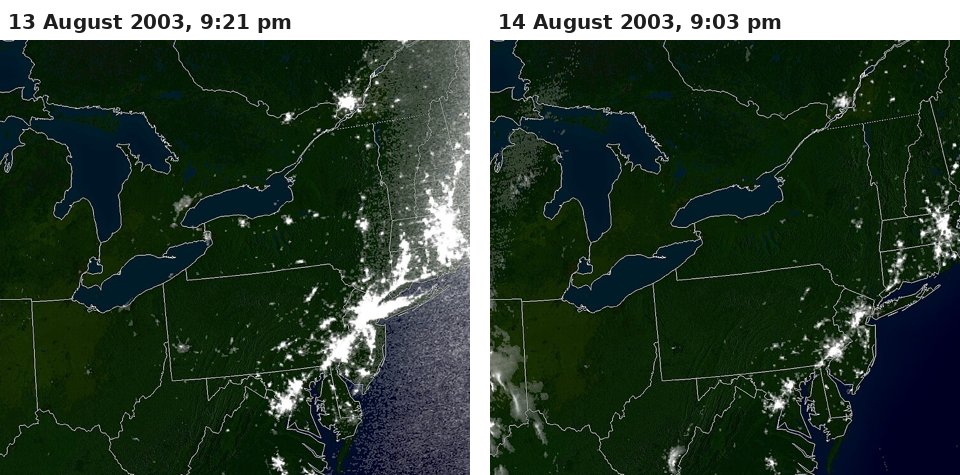
Satellite imagery: National Oceanic and Atmospheric Administration, public domain, via Wikimedia Commons.
The investigation found the overgrown trees, the poor planning, and the training gaps. But the governance finding is the one that changed the industry. Before 2003, the reliability rules power companies were supposed to follow were voluntary. The task force recommended making them mandatory and enforceable, and Congress did, because it had become clear that a rule nobody has to follow and nobody checks is not a rule.2
The link that broke: who checks. The component: software. Notice the specific shape, because it comes back in the main case. The failure was not that a monitor broke. It was that a broken monitor looked exactly like a working one, and no person or process owned the question of whether it was still working.
Show the answer
The pattern is a check whose silence means either "all clear" or "broken," and nobody can tell which. A smoke detector with a dead battery looks exactly like a smoke detector in a house with no fire. A monitoring dashboard that has stopped updating looks exactly like a system with nothing to report. A spam filter that quietly stopped running looks like a day with no spam. The fix is the same in every case: something has to prove the check is alive on a schedule, a test alarm, a heartbeat, a weekly "is this thing still on?" that somebody owns. FirstEnergy's alarm had been dead for an hour before anyone knew, because nothing checked the checker.
3.2 Mini-case 2 · 1999 to today: the convictions that had to be undone
In 1999 the British Post Office rolled out an accounting system called Horizon across thousands of branches. Many branches sit inside ordinary shops, and each was run by a subpostmaster, a local business owner who was contractually liable for any shortfall in the branch's accounts. The system reported shortfalls that were not real.
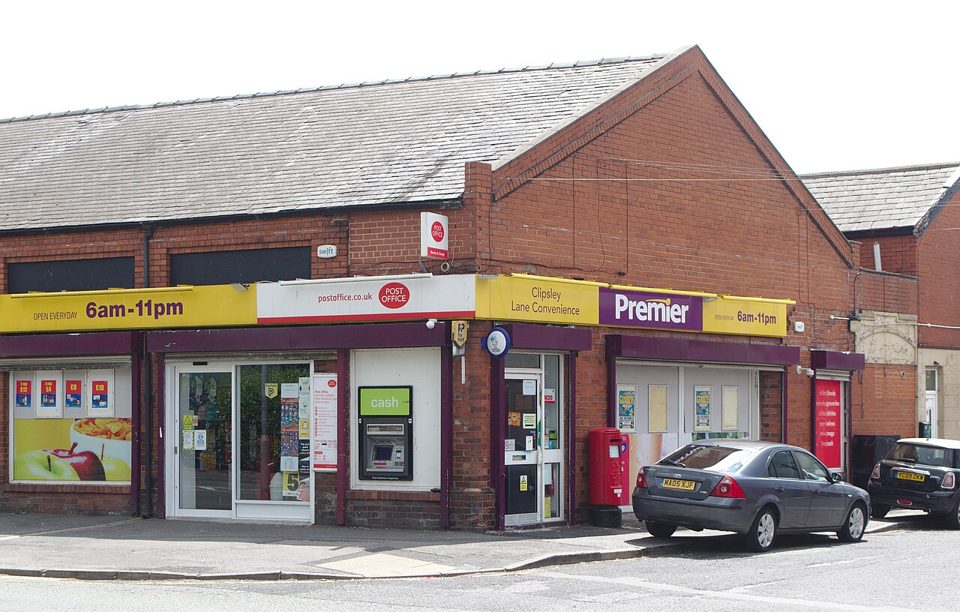
Photograph: Rodhullandemu, via Wikimedia Commons, CC BY-SA 4.0.
What the Post Office did next is the reason this case is in a governance chapter rather than a software one. It insisted the system was reliable, and used that position to pursue the people the system was failing. More than seven hundred subpostmasters were prosecuted, many for theft or false accounting. People lost their businesses, their homes, and their reputations. Some went to prison. Some died before the record was corrected.3
From 2021, British courts began overturning the convictions, and a public inquiry was set up. Its first report, in July 2025, found that the scandal had affected at least 10,000 people and that at least thirteen people are believed to have taken their own lives as a result. It also found that senior people at the Post Office and its supplier knew, or should have known, about the defects.3 The rest of the report, the part that says who was responsible, had still not been published by autumn 2026; in July 2026 the inquiry's chair said it needed several more months.3 The failure began before most of you were born and is still not finished.
The link that broke: who answers. The component: people. Accountability did exist here, and that is what makes this the most disturbing case in the book. It was assigned, formally and in writing, to the subpostmasters. When the system was wrong, the structure was already built to conclude that the people must be.
Show the answer
The Post Office delegated the responsibility, the building and running of Horizon, to Fujitsu, and that part is ordinary; companies outsource systems constantly. What it tried to delegate was the accountability for what the system said. It treated Horizon's figures as proof and the subpostmasters as guilty, as if the truth of the records belonged to the vendor rather than to the organization prosecuting people on them. That cannot be handed off. The Post Office chose to prosecute, on evidence it owned, and the courts, the inquiry, and the compensation schemes have all held the Post Office to account. Fujitsu has since told Parliament it has a moral obligation to help pay compensation, which is responsibility, not the accountability for choosing to prosecute. Whoever acts on a system's output answers for it, whether or not they built it.
3.3 What the two have in common
An alarm and a branch accounting system. In neither case was the failure a mystery once anybody looked, and in both the organization had a governance structure on paper.
What the two share is that the structure did not properly answer one of the four questions. Nobody owned whether the alarm was alive. And in the second case, the question of who answers had been settled in advance, in the organization's favor, against the people with the least power to argue.
Keep the second one especially close for the main case. Equifax is usually taught as a story about a missed patch, and it is. But it is also a story about a company holding data on about 147 million people who were never its customers and never agreed to anything.
4Main case · Equifax: a patch nobody applied
If you have ever applied for a credit card, a car loan, or an apartment, someone probably checked a file about you held by a company you never chose. Most people never think about that file until the day they learn a stranger has a copy. In September 2017, about 147 million Americans learned exactly that. To see how it happened, follow the story in the order it happened.
None of it required brilliant attackers. Every safeguard that would have stopped it already existed and was already understood, which is why this is the governance chapter. Five numbers set the scale:
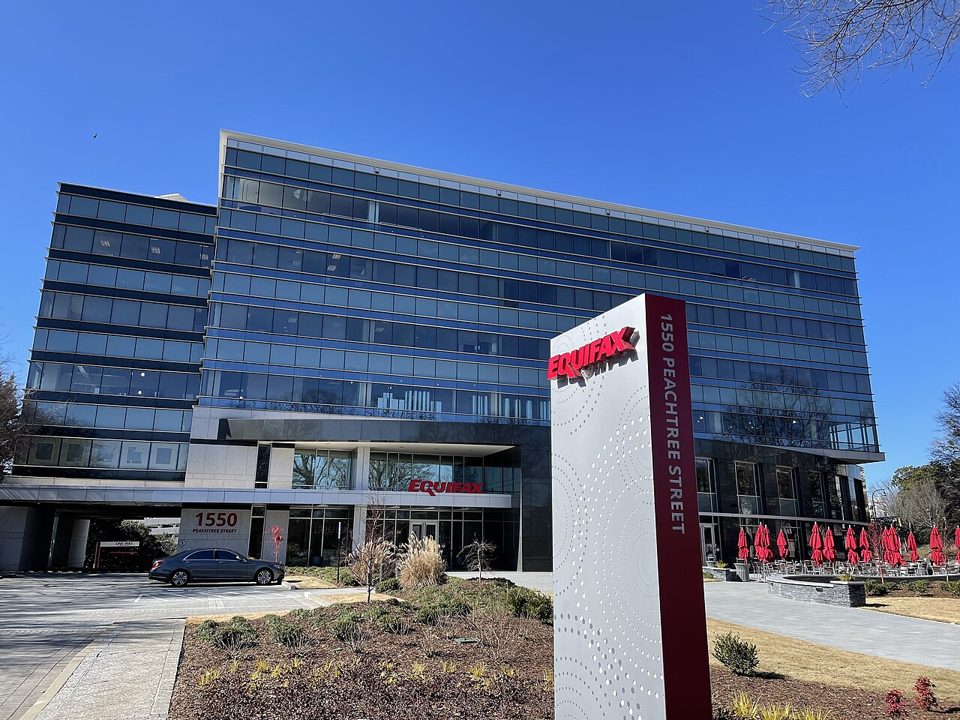
Photograph: Tyler Lahti, via Wikimedia Commons, CC BY-SA 4.0.
4.1 The company nobody signed up for
Equifax is one of three national credit bureaus in the United States. Its customers are lenders, landlords, insurers and employers, who pay to see a file. The people described in those files are not customers and never were. Banks, card issuers and collection agencies send in payment histories, and the bureau matches them to a person, usually by Social Security number. Nobody in the file applied, agreed or signed anything, and nobody can withdraw. If you have ever pulled your own credit report, you were reading a file you did not open and cannot close.
That shapes the governance problem before a single server is switched on. In an ordinary company the people whose data is at risk are the people who can walk away, so protecting them and keeping the business are the same job. At a credit bureau those are two different jobs, and only one of them has a customer attached.
The second thing to know is how the technology got there. Equifax grew by buying companies, and buying a company means inheriting its systems rather than designing them. The system the attackers used was the consumer dispute portal, called ACIS, which is where a person who believes their file is wrong goes to argue about it. The House Oversight committee's report traces its custom-built code back to the 1970s, running on the public internet in 2017.4
Read that as a governance fact rather than a technical one. Nobody decided to leave a portal from the 1970s facing the internet. A decision has a decider, and this had none. It had simply never come up, because the part of the system that serves the people in the files, rather than the customers who pay for them, is the part nobody's budget is measured on.
4.2 The patch that was ordered
On 7 March 2017 the Apache Software Foundation published a fix for a serious flaw in Apache Struts, open-source software used to build Java web applications. The flaw let an attacker send a request that the server executed as a command. Its catalogue number is CVE-2017-5638, and the sensible response to it was to install the update that day.
On 8 March, US-CERT, the federal body that warns organizations about exactly this, sent Equifax the alert. On 9 March Equifax passed an internal notice to its technical staff telling them to apply the patch within 48 hours.5 Take a moment with that, because it is the part people get wrong about this case. The company was told. The company knew. The company issued the correct instruction inside 24 hours, which is faster than many organizations manage.
The notice went out on an email distribution list, and the list was out of date. It did not reach everyone responsible for a system running Struts.4 A company can hold a correct policy and an incorrect mailing list, and when those two disagree, the mailing list wins. This is the first of the four governance questions failing: who does the work. Somebody made the decision correctly and then handed the work to a list instead of to people, and a list cannot be accountable for anything.
4.3 The scan that found nothing
Six days later, on 15 March, Equifax ran scans to find any system still carrying the vulnerability. The scans came back clean. ACIS was running the vulnerable software at the time and was not among the results.5
There are two reasons a scan misses a system, and Equifax had both. The scan did not cover everything it needed to cover, and the company had no complete inventory of which software ran on which machine, so there was no list to check the results against. An internal audit two years before the breach had already reported that nobody enforced patching against the company's own schedules, that staff had no full asset inventory, and that the whole process ran on something close to an honor system. Most of what that audit recommended had not been done by 2017.4
Now put the scan next to mini-case 1, because they are the same failure in different clothes. FirstEnergy's operators watched a screen that looked normal, and it looked normal because the alarm system had died. Equifax's staff read a scan result that said nothing was vulnerable, and it said that because the scan could not see the vulnerable machine. A check that cannot see a system reports exactly what a check reports when the system is healthy. Silence means either "all clear" or "I am broken," and nothing in either organization was responsible for telling those two apart.
That is the third governance question failing: who verifies it was done. Equifax verified. The verification was worthless, and no part of the structure was built to notice that.
4.4 Seventy-six days inside
On 13 May 2017 attackers used the unpatched portal to get into the network. They stayed until 29 July, which is 76 days.5
What they found inside matters more than how they got in, because the way in was one mistake and what followed was a series of decisions nobody had made. Equifax kept administrative credentials in plain text on a file share, so breaking into one portal handed an attacker the keys to other systems. The databases were not separated from one another, so a compromised dispute portal could reach databases that had nothing to do with disputes. The attackers ran roughly 9,000 queries, looking like authorized users because they held authorized credentials, and sent the results out in small encrypted pieces.5 Count the failures you have just read: one patch, one file of plain-text passwords, one flat network. Now ask yourself which of the three you could have fixed in an afternoon, and why you think nobody did.
None of that is an attack on governance. It is the shape of a network that governance never made a decision about. Segmentation is not a product you buy; it is somebody choosing, in advance, that this system may reach that one and no further, and then somebody else checking that it is still true. Equifax's technology was doing what it had been built to do. It had been built by nobody in particular, over decades, out of other companies' systems.
4.5 The monitor that had stopped watching
Equifax owned a device whose job was to inspect the traffic going in and out of ACIS. To read encrypted traffic, that device needed a valid security certificate. Its certificate had expired, and nothing told anyone. For as long as it stayed expired, the device sat in the rack, powered on, showing nothing wrong, and inspecting nothing.
The two official investigations give different lengths for that blindness. The House Oversight committee reports that the device had been inactive for 19 months. The Government Accountability Office puts the expiry at about ten months before the breach. Either number is longer than the 76 days4 the attackers spent inside, which is the point worth keeping: the detection failure was not a consequence of the attack, it was older than the attack.
On 29 July an Equifax employee renewed the certificate. The device came back to life and immediately showed suspicious traffic leaving the dispute portal. On 30 July the company took the portal offline and the intrusion ended.5 That is the whole distance between a breach running unseen for two and a half months and a breach caught the same day: one expired certificate, renewed.
The committee also found that at least 324 of the company's security certificates had expired, 79 of them on business-critical domains. That number is the real finding. One expired certificate is an oversight. Three hundred is an answer to the question "whose job is it to know when these expire," and the answer is nobody's.4
4.6 Six weeks before anyone was told
On 31 July the chief information officer told the chief executive that something had happened. Equifax brought in outside investigators and spent August working out how much had gone and whose it was. It told the public on 7 September, six weeks after it took the portal offline.5
Some of what happened in those six weeks is why the case became a political event rather than a security story. Executives sold company shares during the gap. Two employees were later convicted of insider trading, one of whom went to prison for four months.6 Equifax then put its breach response on a brand new website with a name of its own rather than on its main domain, which taught 147 million worried people to type an unfamiliar address and trust it. A security researcher registered a lookalike address to prove the point, and Equifax's own social media account sent people to the fake one several times.4
When the chief executive testified to Congress in October, he attributed the breach to human error and a failure to communicate the need for the patch. That is an accurate description and a useless one. "Human error" is what an accountability gap sounds like when the person accountable describes it. Somebody did not act on an email. The governance question is not who that was. It is why a control the company depended on was allowed to rest on one person reading one email, with nothing downstream that would notice if they did not.
4.7 The same failure, laid on a framework
Section 2 said a framework turns intentions into questions an outsider can check. In 2017 the NIST Cybersecurity Framework had five functions. Lay this breach on them and see how precisely it locates the damage.
Identify failed halfway: the company knew about the vulnerability and did not know everywhere it ran. Protect failed on one server. Detect failed for months before anyone tried anything. Respond failed in public for six weeks. Four of the five functions, each failing in a different department, all tracing back to the same missing sentence: nothing in the company required a named person to prove that a task had landed on every machine it applied to.
A framework would not have installed the patch. What it does is force somebody to answer the question "show me that every internet-facing system got this fix," in a meeting, with a document. That question would have found ACIS in March. No one at Equifax was structurally required to ask it, and a company only answers the questions somebody has to ask.
Now look at what NIST did in 2024. It added a sixth function, govern, covering strategy, roles, and oversight: exactly the missing sentence above.1 The framework that existed in 2017 could tell you which functions failed. It had no function for the thing that made all four fail together. Its authors have since agreed that “who is in charge of this?” is a security control in its own right.
The compliance trap from section 2 is here too, in a form worth remembering. Equifax was a regulated company that had been audited. The Federal Trade Commission's complaint, filed after the breach, described administrative credentials kept in plain text and copies of real Social Security numbers sitting in development and test systems that employees and contractors could reach with no business reason to.7 All of that was true on days the company was compliant. The paperwork was not lying. It was measuring something else.
4.8 What happened to everybody afterward
The chief information officer and the chief security officer both retired within a week of the announcement. The chief executive retired three weeks later. None of them had touched the unapplied patch, which is the point section 1 made in advance: accountability nobody assigns in advance ends up at the top, because that is the only place it can go.
In July 2019 Equifax settled with the Federal Trade Commission, the Consumer Financial Protection Bureau and the states for at least $575 million and up to $700 million. That included a consumer fund of up to $425 million, $175 million to the states, and a $100 million civil penalty.8 The consumer part is the part students should look at closely. Equifax capped the cash portion of that fund, far more people claimed than the cap assumed. The cash pot was about $31 million, and the FTC ended up telling claimants in public that the advertised $125 would not be what most of them got.8 Many got a few dollars, or credit monitoring instead.
In February 2020 the Department of Justice indicted four members of the Chinese People's Liberation Army for the intrusion. They are believed to be in China and have not been arrested.9 The stolen data has never turned up for sale, which analysts read as a sign this was intelligence collection rather than ordinary crime. That detail matters for how you think about risk: the people in the files cannot even find out whether their information has been used.
Equifax itself announced $1.25 billion of additional security and technology spending across the three years after the breach. Its share price recovered. It is still one of three companies that decide whether an American can get a mortgage. The business survived because, as section 5 will put it, the business never depended on the goodwill of the people in the files.
4.9 The five components at Equifax
Now that you have seen the whole system, here it is as five components, the way this course maps every case. Look at which rows failed. Both were the cheapest, most routine parts of the whole system.
| Component | In the breach | The governance lesson |
|---|---|---|
| Hardware | One internet-facing server running vulnerable software | Every critical box needs a named owner |
| Software | The unpatched Apache Struts; the expired monitoring certificate | Known fixes are worthless if no process guarantees they land |
| Data | 147M identities: the product, not the customer | Holding data creates duties to people who never agreed |
| Networks | 76 days of extraction past a blinded monitor | Detection is a governance duty, not a one-time purchase |
| People | Responsibility everywhere, accountability nowhere; three executives gone | Unassigned accountability rolls to the top |
4.10 What's next: what has changed since, and what has not
Inside the company, a great deal. Equifax rebuilt onto cloud infrastructure, put in asset inventory and patch deadlines it now reports against, and moved its security leadership to report to the chief executive with a board committee above it. Those are governance changes rather than technical ones. They are answers to "who decides, who does, who checks, who answers," and they arrived only after Congress asked the question in a hearing room.
Outside the company, much less. American consumers can now freeze their credit files for free at all three bureaus, which Congress required in 2018 and which is a genuine improvement. There is still no general federal data privacy law. By 2026, about twenty states had passed privacy laws of their own, and dozens of federal bills had been introduced without one passing.10 The people in the files still cannot leave, still did not agree, and still have no vote on how their records are kept.
Hold that against mini-case 1 one last time. After the 2003 blackout, Congress took the reliability rules the industry was supposed to follow and made them mandatory and enforceable, because voluntary rules nobody verifies are not rules. After Equifax, the United States fined one company and changed almost nothing about the obligations of the industry it belongs to. If you want to know whether a governance failure has been fixed, do not ask whether somebody was punished. Ask whether the rule that failed is now compulsory and checked.
4.11 What a business technology manager takes from this case
Strip the Equifax case down to what you can reuse in any company. Four decisions came up in it, and each one is a decision you will be in the room for.
Put a name next to every routine task, or it belongs to nobody. Equifax's patch was ordered, and it was not applied to one server, because the job lived in the space between teams. The 2003 alarm was dead for an hour because nobody owned checking that it was alive. Governance is mostly the unglamorous work of writing a name beside each task, and it is where most large failures live.
Keep responsibility and accountability apart, and know which one you hold. The person who does the work is responsible; the person who answers when it goes wrong is accountable. The Post Office outsourced the system to Fujitsu and still answered for every prosecution, because it acted on the numbers. When you sign off on something you did not build, you have taken the accountability whether or not you noticed.
Do not mistake passing an audit for being safe. Equifax had policies on paper and had been audited, and the certificate that was supposed to catch the theft had been expired for months. A framework tells you which questions to ask. Only the answers, checked, tell you whether you are protected.
Remember whose data it is. The 147 million people in Equifax's files were never its customers and never agreed to anything. They could not take their business elsewhere, because they had never given it. When your company holds data about people who did not choose you, the ordinary market check on your behavior is gone, and governance is the only thing left. Section 5 is about what that costs them.
5The downside: data about people who never agreed
There is a fact about Equifax that makes its breach different in kind from a retailer losing card numbers, and it deserves to be stated plainly. The 147 million people whose data was exposed were never Equifax's customers. They never signed up, never agreed to terms, never chose to do business with the company at all. Equifax's customers are lenders. The people in its database are its product: their financial histories, collected without their direct involvement, packaged and sold to others.
That fact inverts the usual accountability relationship, and it is the deepest governance question in the chapter. A normal company that loses customer data faces those customers in the market: they can leave. The people harmed by the Equifax breach had no such lever, because they were never in a relationship they could exit. You cannot boycott a company you were never a customer of. When the people bearing the risk are not the people the company answers to, the market cannot govern the outcome by itself. Governance has to come from somewhere else: regulation, law, and accountability assigned by force rather than by choice.
Chapter 9 called breach costs an externality, and Equifax is the extreme case. A Social Security number cannot be reissued. The 147 million people in the Equifax breach carry a lifetime exposure to identity theft that no settlement retires. The roughly $700 million Equifax paid in 2019, split among restitution, credit monitoring, and penalties, works out to a few dollars of face value per person for a permanent risk. The company continues to operate and remains one of three firms that decide whether Americans can get a mortgage. The breach did not end the business, because the business does not depend on the goodwill of the people it holds data about.
Hold all of this against the second question of the course. "Does the system work?" Equifax's data system worked extremely well, at collecting, matching, and selling. The question this course insists on adding, "for whom, and at whose expense?", is the entire content of the Equifax story. It is why the answer to a governance failure this large is not only a better patch process. It is a public argument about who should be allowed to hold what data about whom, and under what obligations. That argument is bigger than any one company, and it is still going on.
- Governance is what decides whether the five components are looked after at all. It sounds bureaucratic until you watch its absence.
- Responsibility is the obligation to do the work. Accountability is the obligation to answer for the outcome, and it belongs to one named person or it belongs to nobody.
- A framework turns vague intentions into auditable commitments. Compliance measures whether documented controls exist, not whether every real system is covered every day.
- Equifax's patch failed in the space between teams. A fix existed, was known, was available, and had been ordered. Nobody was accountable that it landed.
- When the people bearing the risk are not the people the company answers to, the market cannot govern the outcome. Governance has to come from somewhere else.
6Vocabulary
- IT governance
- The structures and decision rights that determine who directs, does, checks, and answers for technology.
- Responsibility
- The obligation to do the work.
- Accountability
- The obligation to answer for the outcome; cannot be shared away.
- Patch management
- The process ensuring known fixes actually reach every affected system.
- Patch
- A fix a software maker publishes for a known vulnerability.
- Asset inventory
- A complete list of the hardware and software an organization runs, and where.
- Vulnerability
- A known weakness attackers can exploit; the Struts flaw was one.
- Framework
- A structured, auditable set of accepted practices (e.g., NIST CSF, COBIT).
- Compliance
- Meeting a standard's requirements; a floor, not proof of security.
- Audit
- An independent check that controls exist and are followed.
- Data stewardship
- The duty of care owed by whoever holds data, especially about people who did not consent.
- Externality
- A cost borne by people outside the decision; central to both security chapters.
7Discussion questions
None of these get handed in. In class you run the discussion and I steer it, which means the class is only as good as what you walk in with. Read the chapter, pick the question you have the strongest opinion about, and be ready to say it first.
- Take a critical recurring task at an organization you know: backups, software updates, access reviews, key handovers. Answer section 1's four questions for it. If any answer is "I am not sure", say what that tells you. Apply
- After the breach nobody could be cleanly blamed for the missed patch. Explain why that is the diagnosis rather than the exoneration, and describe the smallest change to the structure that would have produced a different outcome. Analyze
- Map the failure onto the five functions of the NIST framework and say which function failed worst. Then say honestly whether adopting a framework would have prevented this, and what else would have had to be true. Systems
- The Post Office had assigned accountability in writing to the least powerful people in the chain, and Equifax had assigned it to nobody. Design an accountability arrangement for a system whose errors fall on people outside the organization, and name who you would give the authority to stop it. Apply
- The settlement worked out to a few dollars of face value per person for a permanent, unfixable exposure, and the company still operates as one of three that decide whether Americans can get a mortgage. Is that an acceptable outcome? Argue one side, state the strongest objection to your own position, and say what a better remedy would actually look like. Ethics
8From lecture to lab
Chapter 9 gave you the controls. This chapter says a control with no named owner is not a control. Lab 8: Security and Data Governance: The Audit is where you find out whether that is easy to say and hard to do.
The access-and-ownership matrix you build for Cascadia is a governance artefact, not a technical one. For every system, you are answering section 1's four questions: who decides, who does the work, who checks it was done, and who answers when it was not. When you find a system where one of those answers is blank, you have found the co-op's version of an unpatched server.
Go to Lab 8 →9Sources and further reading
- 1 NIST, “NIST Releases Version 2.0 of Landmark Cybersecurity Framework,” 26 February 2024, for the sixth function, Govern, added to the original five. Sections 2.1 and 4.7.
- 2 U.S.–Canada Power System Outage Task Force, Final Report on the August 14, 2003 Blackout (April 2004), announced by the U.S. Department of Energy, for the alarm failure at about 2:14 pm, the first tree-caused line trip at about 3:05 pm, the cascade, up to 50 million people affected, and the recommendation that reliability standards be made mandatory; and the Task Force’s one-year follow-up. Mini-case 1.
- 3 The Register, 22 July 2025, and Computer Weekly, “Post Office Horizon scandal explained”, for volume 1 of the inquiry’s report (July 2025): at least 10,000 people affected, at least thirteen suicides believed linked, and the finding that senior staff knew or should have known; the inquiry’s reports page, for the chair’s 8 July 2026 update on the remaining volumes; and the House of Commons Business and Trade Committee, “Justice for the sub-postmasters,” March 2026, for Fujitsu’s statement of a moral obligation to contribute. Live; check the remaining volumes before teaching. Mini-case 2.
- 4 U.S. House Committee on Oversight and Government Reform, The Equifax Data Breach, majority staff report, December 2018, for the age of the ACIS portal, the out-of-date email list, the 2015 audit findings, the 19-month inactive monitor, the 324 expired certificates (79 on business-critical domains), and the lookalike website. Equifax said the report contained significant inaccuracies. Sections 4.1 to 4.6.
- 5 U.S. Government Accountability Office, Data Protection: Actions Taken by Equifax and Federal Agencies in Response to the 2017 Breach, GAO-18-559, August 2018, for the timeline: the 9 March notice, the 15 March scan, the 13 May entry, about 9,000 queries, the 29 July renewal, the 30 July shutdown, and the 7 September announcement. Sections 4.2 to 4.6.
- 6 U.S. Attorney’s Office, Northern District of Georgia, “Former Equifax employee sentenced for insider trading,” June 2019, for Jun Ying’s sentence and Sudhakar Bonthu’s earlier guilty plea. Section 4.6.
- 7 U.S. Federal Trade Commission, complaint against Equifax (July 2019), for administrative credentials stored in plain text and real Social Security numbers in development and test systems. Worth reading beside the company’s audit record for the same period. Section 4.7.
- 8 Global News, February 2020, and Engadget, 10 February 2020, for the July 2019 settlement structure (at least $575 million, up to $700 million) and the roughly $31 million cash pot that left most claimants with far less than $125; also the FTC and CFPB announcements of 22 July 2019. Section 4.8.
- 9 TechCrunch, 10 February 2020, on the Justice Department’s nine-count indictment of four members of the PLA’s 54th Research Institute. Section 4.8.
- 10 IAPP, US State Privacy Legislation overview, and Stacker, October 2026, on the 49 federal privacy proposals and no comprehensive federal law. Section 4.10. Recheck each term.
- COBIT, from ISACA, for section 2.1. Freely described on ISACA’s site; worth ten minutes beside the NIST framework, because seeing how plain the language is removes most of the mystique.
- Images. Blackout satellite imagery, National Oceanic and Atmospheric Administration, before and after, public domain, cropped and placed side by side. Post Office branch in Haydock, photograph by Rodhullandemu, 2021, Wikimedia Commons, CC BY-SA 4.0. Equifax headquarters, photograph by Tyler Lahti, 2022, Wikimedia Commons, CC BY-SA 4.0. Both diagrams are original to this book.
- Verification note, 29 October 2026 (rebuild). Restructured to match Chapter 7 and re-checked against the entries above; the 18 September 2026 check of the Equifax timeline still stands. Corrections: the NIST Cybersecurity Framework now has six functions, not five; version 2.0 (February 2024) added Govern, and section 4.7 now says the 2017 mapping used the older five. Mini-case 1 had the order wrong: the alarm system failed about fifty minutes before the first line tripped, not after it, and the Task Force figure is up to 50 million people, not 55 million. The Target compliance claim had no source and was removed. “Held certifications” for Equifax was not supported and now reads “had been audited.” “Will not be arrested” was speculation and now reads “have not been arrested.” New: section 2.3 on patch management, asset inventory, and monitoring; the governance-loop diagram; the 2026 status of the Horizon inquiry; the $31 million cash pot; and the 2026 state of U.S. privacy law. Two figures to watch, unchanged: the House reports the monitor inactive for 19 months, the GAO about ten months.