How Spotify Built an AI Factory:
Personalization at Scale
Primary source: This case study is based on Spotify’s engineering blog post The Rise and Lessons Learned of ML Models to Personalize Content on Home (Part I), published by Spotify Engineering, November 2021. Additional context drawn from Spotify’s public investor materials and product documentation.
1 Company Background
Spotify was founded in Stockholm, Sweden in 2006 by Daniel Ek and Martin Lorentzon, launching publicly in 2008. The company was born in direct response to rampant music piracy — particularly the peer-to-peer file-sharing platform Pirate Bay — and was built on a simple but powerful premise: make legal music streaming so frictionless, affordable, and enjoyable that piracy becomes less attractive than paying.
Since its launch, Spotify has continuously expanded what it means to be an audio platform. Its move into podcasting brought a new generation of listeners to the medium, and in 2022 it entered the fast-growing audiobook market. Today, listeners can discover, manage, and enjoy over 100 million tracks, 7 million podcast titles, and 500,000 audiobooks in select markets — all in one place.
Spotify went public on the New York Stock Exchange in April 2018 via an unconventional direct listing, and today operates as one of the world’s most valuable media companies. Its business model relies primarily on a freemium structure: a free, ad-supported tier that drives user acquisition, and a premium subscription tier that generates the majority of revenue. The company also generates revenue from podcast advertising and its creator marketplace. With 751 million users and 290 million subscribers across 184 markets, it is the world’s most popular audio streaming service.
In the music space, Spotify competes directly with Apple Music, Amazon Music, YouTube Music, and Tidal — all of which offer access to essentially the same licensed catalog. This matters enormously for understanding Spotify’s strategy: when the product (music) is the same everywhere, the experience of finding and discovering that music becomes the differentiator. That experience is powered almost entirely by machine learning.
2 Core Concept: AI as Business Strategy
When Spotify tells you that you listened to a particular artist more than 99% of other listeners, or that your most-played song in a given year was something you didn’t even realize you had on repeat, it does not feel like a technology product. It feels personal. That feeling is not an accident — it is the intended result of a deliberate business strategy built on artificial intelligence.
Spotify operates in one of the most competitive markets in the world. Apple Music, Amazon Music, YouTube Music, and Tidal all offer access to essentially the same catalog of songs. The music itself is not a differentiator. What differentiates Spotify is how well it connects each individual listener to the content they will love — and how consistently it does that, for hundreds of millions of people, every single day.
This case examines how Spotify built that personalization capability, what it cost them to get it right, and what the lessons from their experience reveal about AI as a source of sustainable competitive advantage. The framework we will use throughout is the AI Factory model: the idea that the most powerful AI-driven businesses are not companies that simply use AI tools, but companies that have built systems in which data, models, predictions, and decisions continuously reinforce each other to create value.
3 The Business Problem: Scale Kills Curation
Spotify’s catalog contains more than 100 million tracks. A new listener opening the app for the first time faces a choice so large it is effectively no choice at all. Research in consumer behavior consistently shows that when people are presented with too many options, they default to the familiar — they stop exploring, stick to what they know, and eventually disengage. For a streaming platform, disengagement means churn. Churn means lost subscription revenue.
The challenge Spotify faced was not just helping listeners find good music. It was doing so at a scale no human organization could manage. In the early days, Spotify employed editors who built curated playlists and used simple algorithmic rules to surface recently played content. This worked when the platform had tens of millions of users. It did not work when the platform grew to hundreds of millions of users across dozens of languages, cultures, and listening contexts.
Human curation is expensive, slow, and subjective. Rules-based algorithms are fast but rigid — they cannot adapt to individual behavior or changing tastes. Spotify needed a third approach: one that could learn from each listener’s behavior, update continuously, and operate at massive scale without a proportional increase in cost. That approach was machine learning.
The shift was from a music company that used technology to a data company that streams music. That distinction matters enormously, because it changes what you invest in, what you measure, and what you consider a competitive asset.
4 Framework: The AI Factory Model
Before walking through what Spotify built, it helps to have a shared vocabulary for how AI-powered businesses actually work. The AI Factory model describes a five-step loop that converts raw data into business value:
The key insight of the AI Factory is that these five steps are not a one-time sequence — they are a continuously reinforcing cycle. Every decision the system makes generates new data, which improves the model, which improves the next prediction, which leads to a better decision, which creates more value, which attracts more users, which generates more data. Companies that build this loop well develop a compounding advantage that is very difficult for competitors to replicate.
5 Step 1 — Data: Every Action Is an Asset
The first step in Spotify’s AI Factory is data collection. Every time a listener interacts with the platform, that interaction is recorded: every stream, every skip, every search, every save, every playlist addition, every time a user turns off shuffle or replays a track.
A feature vector is simply a list of numbers that describes one thing — all of a user’s features combined into a single row. In Spotify’s case, each listener gets their own feature vector: “This person has played Arctic Monkeys 14 times this month, skips 62% of songs, finishes 91% of indie rock songs, listens mostly at 7am, and listens for 3.1 minutes on average.” A model can’t read that sentence — so it gets turned into numbers: [ 14, 0.62, 0.91, 7.0, 3.1 ]. That list is the feature vector.
Think of it like a customer profile: if the feature vector is the full profile, each feature is a single field on it. Every user gets their own version of the list — the model compares millions of these lists to find patterns and make predictions.
This is what makes data a strategic moat. A new competitor entering the streaming market might be able to license the same song catalog. They cannot license Spotify’s 751-million-user behavioral dataset.
6 Step 2 — Model: Teaching Machines to Know You
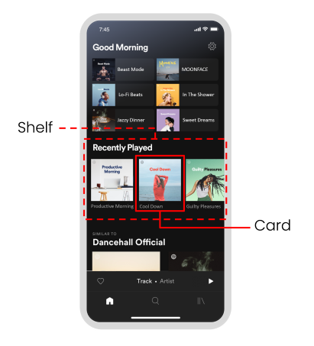
The second step in the AI Factory is building models — the mathematical systems that learn patterns from data and use those patterns to make predictions about future behavior. Spotify’s Home page recommendation system uses a two-stage model architecture. The result of this system is what you see every time you open the app: a series of horizontal rows of content called shelves, each one generated fresh for you by a different specialized model.
Stage 1: Candidate generation
With 100 million tracks in the catalog, evaluating every option for every user every time someone opens the app would be computationally impractical. Candidate generation models solve this by quickly identifying a smaller shortlist of plausibly relevant content. Spotify runs several specialized models at this stage, each powering a different shelf on your Home page:
- The Podcast Model — predicts which podcasts a listener is likely to engage with, powering the “Shows You Might Like” shelf.
- The Shortcuts Model — predicts which familiar content a listener is most likely to return to, powering shelves like “Recently Played” and “Jump Back In.”
- The Playlists Model — designed for newer listeners without a long history, using patterns from similar users to predict relevant editorial playlists.
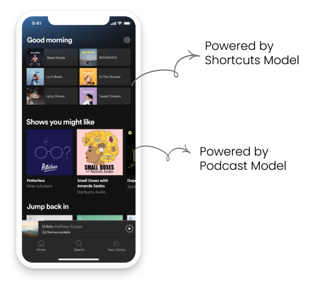
To make this work at scale, Spotify’s recommendation system is built in two parallel parts: one side continuously builds a profile of each user based on their listening history, while the other side builds a profile for each piece of content based on who engages with it and when. The system is trained so that a user and the content they are likely to enjoy end up with very similar profiles — making it fast to find good matches even across a catalog of 100 million tracks.
Stage 2: Ranking
Once the candidate set has been generated, a second model ranks those options in the best order for this specific listener at this specific moment. The ranking stage considers contextual signals — time of day, recent listening activity, session length — to determine not just what is relevant, but what is most relevant right now.
7 Step 3 — Prediction: Real Time, Every Time
Before predictions can be generated, the options have to be narrowed. This is exactly what the two-stage model architecture in the previous section does: the candidate generation models run first, doing a fast sweep of 100 million tracks and cutting the catalog down to a manageable shortlist. The ranking model then scores that shortlist for this specific listener at this specific moment. Only after both stages have run does the system move to the prediction step — deciding when and how to serve those results to the user.
The third step in the AI Factory is generating those predictions — taking everything the models have learned and producing a specific recommendation for a specific person at a specific moment.
In Spotify’s early days, predictions were generated in batches overnight and served the next day. This was simple and cheap, but fundamentally limited: if a listener discovered a new artist on Monday night, their Tuesday morning Home page would not yet reflect that discovery. As competition intensified, Spotify moved to real-time prediction — generating recommendations the moment a listener opens the app. The system feels responsive. It feels like it knows you.
8 Things Can Go Wrong
When Spotify moved the Podcast Model from overnight predictions to real-time serving, they ran into a problem that was small in technical terms but significant in business impact. The model had been trained using data processed in a specific way. When it went live, the incoming data was being processed slightly differently — a small discrepancy in how a single variable was being calculated.
Spotify’s response was straightforward in principle, even if the execution required significant work. In the short term, they fixed the specific mismatch that caused the problem. In the longer term, they made sure it couldn’t happen again — by ensuring the same process was used to prepare data for both training and live use, and by building automated daily checks that would catch any future divergence early, before it affected users for months.
9 Step 4 — Decision: Predictions into Product
The fourth step in the AI Factory is decision-making — using predictions to take a specific action that affects the user experience. At Spotify, this is the Home page itself: predictions generated by the candidate generation and ranking models are translated into shelves — the horizontal rows of content that appear when you open the app. Each shelf has a label (“Recently Played,” “Shows You Might Like,” “Similar to [Artist]”) and is populated entirely by a different specialized model running in the background.
It is worth pausing on the distinction between a prediction and a decision, because conflating them leads to poor AI design.
- A prediction answers: what is this user likely to do?
- A decision answers: what should we show this user?
A model might predict that a user is very likely to replay the same ten songs they always play — but the decision might be to show them something new anyway, because exploration and discovery are part of Spotify’s value proposition. If the decision layer simply executed every prediction blindly, the product would push users deeper into whatever they already know, rather than helping them grow their tastes.
Familiarity vs. discovery: the tension at the heart of Spotify’s strategy
The tension between familiarity and discovery is not a design problem to be solved — it is the core of Spotify’s strategy. Every streaming service can give you what you already know you like. That is not a competitive advantage; it is a baseline. Familiarity keeps you satisfied. Discovery is what keeps you loyal to Spotify specifically.
But discovery only works when it is anchored in familiarity. Surface too much unfamiliar content and the experience feels random and exhausting. Give users only what they already know and the product stagnates. The strategy lives in the balance: enough familiarity to feel safe, enough discovery to feel alive.
This tension runs through every product decision Spotify makes — how Discover Weekly is weighted, how much space emerging artists get on the Home page, how the ranking model balances a sure thing against a calculated risk. And it is not purely a product decision. It is a financial one too. Spotify pays high licensing fees to major labels for well-known content. Emerging and independent artists cost less to serve. Pushing discovery is not just good for users — it improves Spotify’s margins.
10 Step 5 — Value: Wrapped Is the Proof
The fifth step in the AI Factory is value creation — the business outcome that justifies the investment in the four preceding steps. For Spotify, value is created at multiple levels:
- At the individual listener level: discovering an artist you love that you never would have found on your own.
- At the platform level: higher engagement, lower churn, and more subscription revenue.
- At the creator level: smaller artists reaching audiences they could never have accessed through traditional channels.
Spotify Wrapped makes these outcomes visible. Launched every December, Wrapped is a personalized summary of each listener’s year — their most-played artists, songs, genres, and total minutes listened. In 2023, Wrapped generated over 600 million social media posts in the first few days after launch.
Here is the central insight: Wrapped is not a separate product. It is built on the same behavioral data, collected by the same pipeline, processed by the same infrastructure that powers the Home page every single day. Your top artist on Wrapped is determined by the same listening history that the Shortcuts Model uses to predict what you want to hear next Monday morning.
How Spotify actually generated 1.4 billion Wrapped reports
The 2025 Wrapped introduced something new: personalized AI-written narratives describing each listener’s most interesting listening days. Spotify didn’t just pull data and format it — they used a large language model to write a unique story for each of their 1.4 billion users. Making that work reliably at that scale required months of deliberate engineering work around a practice most people don’t associate with infrastructure: prompt engineering.
The team split their prompting strategy into two layers. The system prompt defined the creative contract for every generation — stories had to be data-driven (every insight traceable to actual listening behavior), written in a specific tone (witty, sincere, and quietly playful), and safe by default (no references to drugs, alcohol, sex, or violence). The user prompt supplied the specific context for each listener: their detailed listening logs for the day, a summarized stats block, their overall Wrapped data, the category of interesting day being described, previously generated reports to avoid repetition, and their country for spelling and vocabulary.
Prompting was not a one-time task. It was a continuous loop running for more than three months. The team built a prototype to compare outputs across prompt versions and edge cases, ran LLM-as-a-judge evaluations on sampled outputs, and layered in human review. Creative feedback, technical feedback, and safety feedback all fed into the next iteration.
Additional source: Inside the Archive: 2025 Wrapped, Spotify Engineering, March 2026.
Why Wrapped costs almost nothing to produce: centralized data architecture
Wrapped is cheap to produce because of a fundamental architectural decision Spotify made: centralize all behavioral data in one place. The same pipeline that feeds the recommendation engine also feeds Wrapped, artist analytics dashboards, governance and monitoring systems, and any future product not yet built. This is centralized data architecture — one dataset, many uses. Each new use case costs almost nothing because the infrastructure already exists.
The alternative — decentralized data architecture — is what most organizations end up with by default. Each team or product builds and owns its own data store. The recommendations team has their data, the marketing team has theirs, the artist tools team has theirs. Building something like Wrapped in a decentralized organization would require stitching together three separate data sources — expensive, slow, and error-prone.
Spotify’s decision to centralize is not just a technical choice. It is a strategic one. Every new product or insight draws from the same increasingly rich dataset. The more data flows in, the more valuable every use of it becomes.
The real-world tradeoffs of centralization
Centralization is a strategic advantage — but it comes with genuine risks that any organization adopting this architecture needs to manage. These are not hypothetical concerns.
- Privacy and regulatory exposure. The more data you hold in one place, the larger the regulatory target you become. When Meta centralized user data across Facebook, Instagram, and WhatsApp, it became one of the most powerful personalization systems in the world — and one of the most scrutinized. EU GDPR investigations and FTC scrutiny followed directly from what centralized data makes possible. The better the data, the bigger the exposure.
- Security risk. Centralization creates a single point of failure. The 2017 Equifax breach exposed the personal and financial data of 147 million people in a single attack — made catastrophic precisely because the data was centralized. One vulnerability, maximum damage. Distributed data is harder to use, but it is also harder to steal all at once.
- Organizational politics. When data is centralized, somebody has to own it — and that means somebody else loses control of it. Sales, marketing, product, and finance all have data they consider theirs. Centralization forces a conversation about who governs access, who decides how the data is used, and who is accountable when something goes wrong. That conversation is rarely just technical. It is political — and it is one of the most common reasons data centralization initiatives stall inside large organizations.
11 Competitive Advantage: Why This Is Hard to Copy
If Spotify’s approach is this valuable, why has no competitor replicated it? The answer is that the AI Factory model produces a compounding advantage that is very difficult to replicate from a standing start. Consider what a competitor would need:
- A behavioral dataset of comparable scale — which requires hundreds of millions of users, which requires a product good enough to attract them, which requires personalization, which requires the dataset. This is a circular dependency that takes years to build.
- The organizational capability to build, deploy, and maintain complex ML systems at scale — including the institutional knowledge that comes from having made the mistakes Spotify made and learned from them.
- The governance infrastructure — data validation, monitoring, retraining pipelines — that keeps the system performing reliably over time.
None of these can be purchased or shortcut. It is not the model that competitors cannot copy. It is the entire system — the data, the organizational capability, the governance, and the compounding improvement over time.
12 Summary Table & Discussion Questions
AI Factory model: Spotify mapped
| Step | Spotify example | Business purpose | Key ML concept |
|---|---|---|---|
| Data | Every stream, skip, search, and save logged in real time | Build a behavioral asset competitors cannot replicate | Implicit signals; feature engineering |
| Model | Podcast, Shortcuts, and Playlists models trained on behavioral data | Learn individual preferences at scale | Collaborative filtering; embeddings |
| Prediction | Real-time candidate generation when listener opens app | Deliver relevance at the moment it matters | Online vs. batch inference; training-serving skew |
| Decision | Home page shelves populated with ranked, personalized content | Balance personalization with discovery and creator equity | Ranking; explore/exploit tradeoff |
| Value | Engagement, retention, Wrapped virality, artist discovery | Convert AI investment into measurable business outcomes | AI governance; compounding data moat |
ML vocabulary introduced in this case
Discussion questions
These questions work equally well as written assignments or in-class discussion prompts. For in-class use, questions 2, 4, and 5 tend to generate the most debate.
- Data is the asset, not the algorithm: Apple Music has the same songs and could build the same algorithm. Why can't they replicate Spotify's recommendation system — and what does that tell you about where competitive advantage actually comes from in AI-driven businesses?
- AI systems need human judgment: Spotify's model predicts you want to hear the same ten songs on repeat. But Spotify doesn't just show you those songs. Why not — and what does that tell you about the relationship between what AI can predict and what a business should actually do?
- AI can fail without breaking: Spotify's podcast recommendations quietly got worse for four months and nobody noticed. What kind of organizational infrastructure would have caught that — and why do most companies not have it?
- Building AI is only half the job: The Spotify incident was not a model failure — the model was technically sound. It was a governance failure. What does that tell you about what organizations need to invest in beyond just building the AI system itself?
- Data centralization as strategy: Wrapped costs almost nothing to produce because all of Spotify's data flows through one pipeline. Think of a company in any industry — what would it look like to turn their existing data infrastructure into a product or experience their customers would want to share?
- The AI Factory compounds: Every decision Spotify's system makes generates new data, which improves the next prediction, which creates more value, which attracts more users, which generates more data. Where does this loop break down — and what would you do to protect it if you were running Spotify?
MIS 432 · AI in Business · Case Study · For classroom discussion purposes.